

Five principles for effective retrieval practice
Moving from recognition to recall, from recall to use, and from performance to learning

This post is the latest in a series focussing on key aspects of different areas of teaching and education.


Whenever a practice is mandated, there’s an inexorable tendency for it to lethally mutate. Retrieval practice is a perfect example. When I first started writing about the testing effect as we used to call it, many people found the idea surprising. The idea that attempting to dredge something up from memory was a more effective way to learn it than simply restudying it felt deeply counterintuitive. Surely looking again, rereading, highlighting and “going over” material ought to work? The fact that it seemed to contradict teachers’ lived experience made sure people responded in one of two ways. While some dismissed it as obviously wrong, others grappled with the idea in order to make sense of the discrepancy. This meant that those who began using retrieval practice in their classrooms usually did so with a degree of care. If they didn’t get the predicted results straight away, they’d rethink, go back to the source material, tweak the task, adjust the timing and try again. In other words, early adoption tended to be thoughtful because we were finding our way.
Today, retrieval practice is so much a part of the furniture that new teachers are routinely told to ‘do’ it without anyone ever explaining the underlying processes. It’s built into lesson expectations and bandied about as if it were beyond dispute. It’s travelled from interesting research finding to institutional commonplace.
Unsurprisingly, that’s been the cause of thousands of misbegotten versions of the ‘retrieval practice’ which copy the superficial appearance and ignore the meachanisms that make it work; a bit like copying the minty taste of toothpaste but leaving out the fluoride.
A powerful cognitive principle has, in too many classrooms, become an empty ritual. Students write down questions from the board. Some can’t answer them. The teacher reveals the answers. Students copy them in green pen. Everyone has technically ticked a retrieval shaped box but no actual retrieval practice has taken place.
Students learn either that the opening minutes of a lesson are a bit of administrative grit to endure, or — worse — that they routinely experience failed before the lesson has even begun. The problem is the misguided attempt to turn retrieval practice into orthodoxy.
How forgetting works
Forgetting is normal. We often think we know things we’ve actually forgotten. The more familiar something is, the more likely we are to believe we can recall it whenever necessary. Rereading a page, looking over notes or nodding along to an explanation can make students feel as if something has been learned. But then, when they need to recall the knowledge unaided, it isn’t there.
Retrieval punctures the illusion, showing students what they can and can’t bring to mind. More importantly, the act of trying to remember also strengthens the very knowledge it tests. The effort of dredging through our memory makes future remembering more likely.
But this doesn’t mean any old quiz is retrieval practice. Neither does it mean all lessons should begin in the same way, or that disconnected interleaving is always the best use of the opening minutes. And it certainly doesn’t mean retrieval is the whole of learning.
The New Theory of Disuse helps distinguishes between two kinds of strength in memory: storage strength refers to how firmly knowledge is embedded in long-term memory and how likely it is to endure, whereas retrieval strength refers to how accessible that knowledge is right now.
If knowledge vanished entirely, there would be nothing to retrieve. We’d have to relearn everything from scratch every time we forgot. But that’s not the case. When we forget, the route between here and now and what we want to know has weakened. A cue, a first letter, a familiar context or a partial prompt is often all it takes to make the answer available again. This explains why relearning is significantly quicker than first learning; a trace remains, even when he cannot being something to mind unaided.
When students cannot provide an answer, it might mean one of several things:
They never learned it in the first place.
They learned it, but not securely enough. Either the cue isn’t strong enough to access it or the retrieval interval was too long, so access has weakened.
They’ve confused it with something similar
The question is badly phrased or asks for the knowledge in an unfamiliar way
They’re anxious, rushed or worried about being wrong.
Obviously, we cannot retrieve what we don’t know. Before students can retrieve anything, it has to be explained, modelled, practised and corrected. Retrieval stabilises knowledge but it can’t conjure it from the air. The important point is that “they don’t know it” isn’t a diagnosis, just the first step in creating more flexible, durable learning.
Performance vs learning
Understanding the difference between retrieval and storage stength helps explains why responses to recent teaching can be so misleading. If students have just been taught something, retrieval strength may be high because the material is still warm. They can recall it at the end of the lesson, answer questions on it, and appear to have made progress. But this immediate performance tells us more about temporary accessibility than durable learning.
Storage strength works differently, growing through successful retrieval event after some forgetting has taken place. When students have to work to bring knowledge back to mind, and succeed, that effort strengthens future access.
The paradox is that attempts to maximise performance now can reduce learning later. If we keep knowledge constantly available, over-prompt students, reteach before they have tried to retrieve, or test only what’s just been explained, we raise retrieval strength in the short term. Students appear successful because the answer is close at hand. But because retrieval is too easy, storage strength doesn’t grow. If a memory hasn’t had to be searched for and reconstructed it hasn’t been strengthened.
This is why ‘getting it in the lesson’ is such weak evidence. It may show only that temporary retrieval strength was high but conceals the likelihood that knowledge is less durable.
Although retrieval practice should be less fluent than simply rereading or being told an answer, the difficulty has to be desirable. If students fail to retrieve an answer, they’re not strengthening access. Often students are guessing, waiting or copying. Likewise, if knowledge is retrieved but never used, instructional gains will be limited.
The crucial point of retrieval practice is not to make students perform well here and now but to improve the chances of performing well elsewhere and later. Retrieval strength is what students can access right now; storage strength is what makes that access more durable tomorrow. Effective retrieval is always oriented to the future.
The following principles are all designed to focus on improving performance in the longer term:
Recall beats recognition
Success before struggle
Retrieval should serve the curriculum
Secure then use
Make it visible
1. Recall beats recognition
We often mistake familiarity for knowledge. Students recognise the term, remember seeing a diagram, can nod along to an explanation, and can pick the right answer from a list. But the real test is whether they can produce the answer when support is taken away.
Rebecca Lawson’s study, The Science of Cycology, exposes the illusion of knowledge. Lawson asked people to complete drawings of bicycles by adding missing parts such as the pedals and chain. Bicycles are hardly exotic and we’ve all seen thousands of them. Most of us can ride a bike and many even own one. But when asked to reconstruct how a bicycle actually fits together, participants made frequent and serious errors: chains went to the wrong wheel and pedals appeared in impossible places. Lawson’s conclusion was that people’s understanding of familiar everyday objects can be sketchy and shallow, even when the information is often seen and easily perceived.
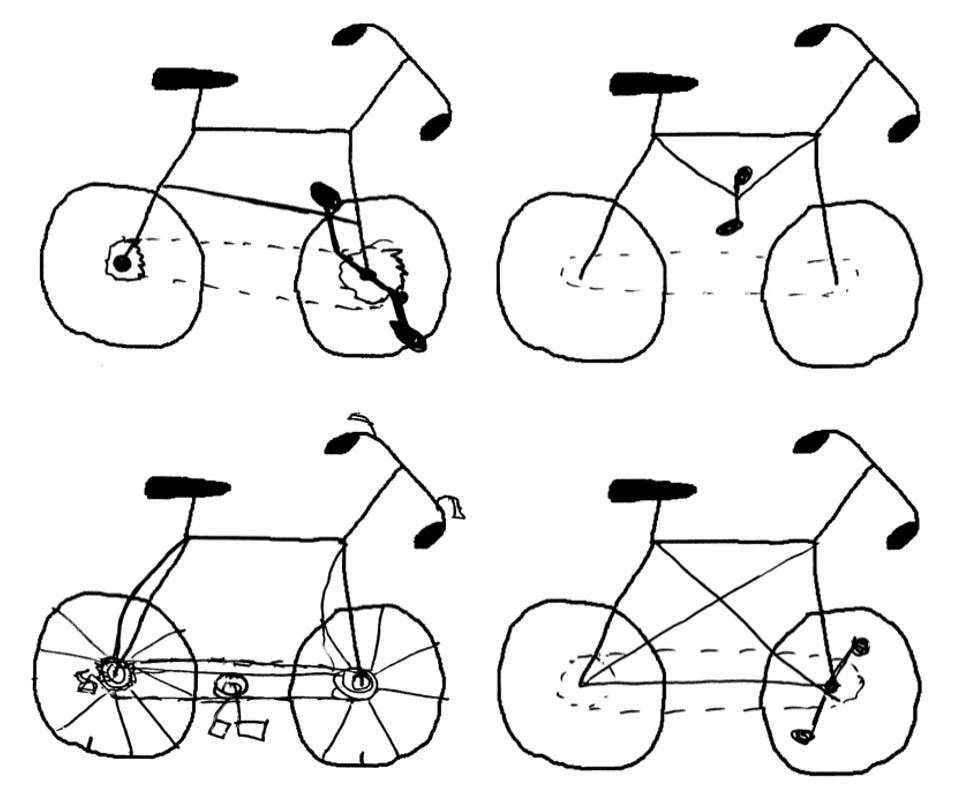
Familiarity flatters us. Because we know a thing when we see it, we assume we know all about it. But while recognition is cheap recall is costly. And paying that cost is the point of retrieval practice.
The illusion of knowledge is endemic in the classroom, reiforced day after day, lesson after lesson. Students may recognise Pythagoras’s theorem when it appears in a list, but be unable to state it. They may recognise the word “mitochondria”, but be unable to define it. They may be able to spot a quotation from Macbeth, but be unable to bring it to mind when writing an essay. They bobble along with the comforting feeling of knowing stuff without the usable possession of anything.
Retrieval practice works because students have to bring knowledge back from memory and are confronted with unambiguous evidence or what they do and don’t not know. As we’ve seen, it’s the effort of retrieval that strengthens future recall. This means it’s important to structure retrieval questions that provide enough of a cue to prompt a search of memory without actually giving away the answer.
Which of the following versions of the same question is easier to answer?
A Who is Scrooge’s dead business partner in A Christmas Carol?
B Who is Scrooge’s dead business partner in A Christmas Carol?
a) Bob Cratchit
b) Jacob Marley
c) Fezziwig
d) Fred
B is obviously easier because it dangles the answer in front of students, just waiting to be recognised. Students can get it right because they recognise Jacob Marley as the right answer but they haven’t had to dredge up anything from memory in an effort to recall it. Of course, the problem with A is that students might try to recall but come up with nothing. As we’ll discuss further in Principle 2, there’s a sweet spot we should aim at but for now, a better restricted retrieval prompt would be:
C Scrooge’s dead business partner is J________ M________.
This gives enough of a cue to start the search, but not so much that students can simply recognise the answer without having to check through previously learned material. If they’ve previously learned the answer they should be able to bring it to mind. The initials narrow the field but the blanks still require recall. That’s the sweet spot: supported production, not recognition.
Multiple-choice questions are often a poor fit for retrieval practice because they are too focused on recognition. Because the answer is provided, students may choose it either because it looks familiar, because the alternatives look wrong, or because the wording gives the game away. This doesn’t mean MCQs are useless. They can diagnose misconceptions, check fine distinctions and, with good feedback, support learning, but they’re a risky default. They may help students access knowledge, but they also cue recognition and expose students to plausible wrong answers. If the aim is fluent recall, students still need to practise producing answers unaided. MCQs are best used for diagnosis, discrimination and discussion, not as the main vehicle for retrieval.1 If we want students to remember, they need to practise producing answers, not merely spotting them.
A retrieval task should usually ask students to produce something: a definition, quotation, term, cause, method, distinction, example, sentence, diagram, step or explanation. “What is Pythagoras’s theorem?” is retrieval. “Which of these is Pythagoras’s theorem?” is recognition.
The best restricted prompts support recall without doing the remembering for students. “The rightful heir to the Scottish throne is M______” is better than asking students to pick Malcolm from a list. The cue narrows the field, but students still have to retrieve the answer. The same principle applies in science: “The structure responsible for generating energy in both plant and animal cells is m___________” supports recall without devolving into recognition.
This is not dumbing down. It is the careful engineering of successful remembering. The point is to give students enough support to retrieve, but not so much that they only recognise.
Good retrieval punctures the illusion of knowledge while students can still do something about it. It shows them that “I know it when I see it” is a long way from “I can bring it to mind when I need it.”
2. Success before struggle
One of the predictable ways retrieval practice goes wrong is by asking students questions that are just too hard. Retrieval is just one of several ‘desirable difficulties’ identified by Robert and Elizabeth Bjork as being likely to support storage strength whilst reducing retrieval strength.2 The difficulty comes from having to remember something you haven’t just been told, not come from being unable to answer. A desirably difficult task is one that requires effort but — crucially — results in success.
Difficulties are only desirable if they lead to successful remembering. If students can’t retrieve the answer, they are not strengthening memory. They’re guessing, freezing, waiting or copying. There’s no useful struggle and no success. There is just time passing as students fail.
This is where so many attempts at retrieval practice go wrong. A question appears. Students don’t know the answer. The answer is revealed. Students write it down. The teacher moves on. Nothing has been retrieved and — probably — nothing has been learned.
Here are some examples of pointlessly difficult questions I’ve seen recently.
English: “What is anagnorisis?”
Maths: “What is the formula for the area of a trapezium?”
Science: “What is the function of the Golgi apparatus?”
History: “What was the significance of the Treaty of Brest-Litovsk?”
Conceivably, this questions might be fine except for the fact that in each case, students gazed at the board blankly and clearly had no idea how to answer. I asked a couple of students about anagnorisis and most of them shrugged. One girl thought it was a type of metaphor. These questions all come from classrooms in different schools, set by teachers trying to leverage the effects of retrieval practice in good faith. Needless to say, you have to know something in order to retrieve it.
The remedy is to ensure retrieval is successful. If students studying Macbeth are asked, “Who is Malcolm?” there’s a lot that can go wrong. Maybe they genuinely don’t know Malcolm is. They may remember hearing his name but not the context. Or, maybe they do know who he is but answer in a way that doesn’t connect with the answer the teacher was looking for. If the teacher is expecting “Malcolm is the rightful heir to the Scottish throne,” but students answer, “One of the guys who ran off after Duncan was killed,” there’s an issue. Although they’re right, the problem was caused by the ambiguity of the question. Now, if instead the teacher had asked, “Who is the rightful heir to the Scottish throne?” we get another set of predictable problems. If Malcolm isn’t familiar enough, this might be too weak a prompt. Students might guess the wrong answer. Worse, they might guess the right answer without necessarily matching the retrieved name to the prompt in their memory. The result of this is a comforting illusion of knowledge because they’ll remember they got the answer right, but not what the answer was.
What about if we tweaked the prompt like this:
The rightful heir to the Scottish throne is M _ _ _ _ _ _.
What will go wrong now? Well, as you’re probably aware, there are a number of plausible candidates whose nemas also begin with M. Students might guess Macduff or even Macbeth. The solution is for the teacher to circulate during retrieval practice to see whether students can answer the question. Now, if we see students are struggling we can add more letters: M _ l _ _ _ m. Even if students need every letter revealed except one, they still having to do a minimal amount of recall. The point is that the level of difficulty should adapt to the level of students’ struggle. If they struggle too much, they clearly need reteaching. If they’re struggling at all, they need more practice. Once they can reliably answer this question without additional promption, we can can then start to ramp up the difficultly and start asking, “Who is the rightful heir…?”
Recall starters should aim for universal success. Not because challenge is unimportant, but because failure at the start of a lesson is corrosive. Students who repeatedly begin lessons by failing learn that they’re rubbish at this subject or that school isn’t for them. This is in no one’s interest.
And yet, aiming for 100% success shouldn’t mean retrieval is easy. Instead it should mean effortful success. Students should have to stretch but they should be able to grasp.
Importantly, this isn’t to make students look impressive but to slow forgetting and build accuracy, fluency and retention. Students need to know that effortless success is the goal. Once they no longer have to think, when they ‘just know’ to right answers, they can start to think with the knowledge they’ve acquired. Accuracy must come first: students need to get it right. Fluency follows: they need to get it right without using up too much mental effort. Retention is the long game: they need to get it right later, when the knowledge is needed for something more demanding.
If students cannot retrieve quickly and successfully on mini whiteboards, the task probably isn’t functioning as retrieval practice. Although it may still be a worthwhile question, a good discussion prompt, or a useful problem, we shouldn’t call everything retrieval just because students are being asked to think.
If most students can’t retrieve the knowledge, that’s a vital piece of information. Perhaps the question needs more scaffolding? Perhaps the content needs reteaching? Perhaps the gap between teaching and recall was too long? Perhaps the previous teaching was less secure than we hoped? Whatever we discover, the point is to repsond.
