


This post is the latest in a series focussing on key aspects of different areas of teaching and education.


Classrooms run on questions. Asking questions and teaching are so closely interwoven that even young children seem to reach for them instinctively when showing someone else how to do something. Sydney Strauss argues that teaching is a natural human cognitive ability rather than a rare professional accomplishment. Children, he suggests, spontaneously teach peers and adults how to play games and carry out tasks, despite rarely being taught how to teach.1 This reminds us that questioning is one of the basic ways human beings direct attention, reveal intention and guide another person’s understanding.
One widely cited estimate suggests that teachers ask between 300 and 400 questions a day.2 Other summaries suggest questioning may occupy roughly 35 to 50 per cent of instructional time.3 By contrast, students ask very few questions in ordinary classrooms. Graesser and Person’s work puts the rate at about 0.11 questions per student per hour, a figure often rendered in later summaries as roughly one question a week.4 The exact numbers should be treated with some caution, since they are drawn from older studies and later syntheses rather than fresh large-scale observation, but the broad pattern is clear enough: questioning in classrooms is still mainly unidirectional. Teachers ask — students answer. Teachers initiate — students respond.
Classroom discourse has long been characterised by what researchers call recitation or IRE/IRF patterns: teacher initiation, student response, teacher evaluation or feedback. The typical student contribution tends to be brief, unevenly distributed, and followed rapidly by teacher judgement.5
If teachers ask hundreds of questions a day, questioning is not some niche technique we can refine at the margins but one of the chief ways lessons are structured, attention is directed, understanding is checked and participation is managed. If questioning is weak, a great deal of teaching goes wrong with it. If it’s skilled, it has the potential to be one of the most reliable mechanisms for leveraging thought and participation. Barrack Rosenshine argues that questioning is not just a means of sampling knowledge but a way to strengthen it: questions help students practise new information and connect it to prior learning. He distinguishes more effective teachers from less effective ones by noting that the former ask more questions, ask more process questions, and check the responses of all students, while the latter ask fewer questions and “almost no process questions”. In practice, a process question is one that asks students to explain how or why they reached an answer, thereby revealing the quality of their thinking rather than just giving the answer.
All teachers are told to ask more questions, ask probing questions, ask open questions, differentiate questions, use cold call, use no hands up, increase wait time. A lot of this advice is sensible but none of it is sufficient. Before deciding how to ask questions, we need to be clearer about what questions are for.
If modelling is the art of making expert performance visible, and scaffolding is the art of making difficulty manageable, then questioning is the art of making thought public. It allows teachers to check attention, secure understanding, develop mastery and prepare students to express ideas with enough precision to support more developed, independent responses. Used badly, questioning becomes a ritual exchange between teacher and student, a way of creating the appearance of engagement. Used well, it is one of, perhaps the most, powerful tools for ensuring students learn.
I’m not claiming the five principles that follow are the only things that matter about questioning, but they are the five that seem most useful to foreground, drawn from both my experience in classrooms and a reasonably thorough reading of the research.
Start with purpose.
Ensure everybody thinks.
Expect everyone to participate.
Treat answers as worth shaping.
Build sequences of questions that develop thought.
1. Start with purpose
The first principle is — I think — the most important: before asking a question, decide what it is for.
This sounds self-evident, but much poor questioning results from the fact that teachers often ask questions generically, as though all questions served the same function. Some questions are designed to check attention. Did students hear the explanation? Are they following the sequence? Have they noticed the feature the teacher wants them to notice? Other questions are designed to check understanding. Have students made sense of what they have heard? Can they connect the example to the concept? Can they explain the relationship between method and meaning, cause and consequence, claim and evidence? Still others are designed to probe mastery. Can students use what they know? Can they apply it in a new context, discriminate between near misses, explain why an answer is right and why an alternative is wrong?

What should be (but often isn’t) clear is that attention is not understanding, and understanding is not mastery. A class may look attentive and still be confused. A student may be able to repeat an explanation and still be unable to apply it. Rosenshine’s emphasis on frequent checks for understanding is best understood in this diagnostic sense. Effective teachers don’t merely ask questions to keep the lesson moving but to find out specific information.
Attention
When checking for attention, the best questions are usually short, closed and tightly tied to what has just been said. My rule is that I never ask this sort of question unless I’ve already taught the answer. Their purpose is not to explore the depth of students’ thinking but to confirm that they are mentally present and tracking the explanation. Most often, this questions is a variety of, “What did I just say?” In English, that might be, “What word have I just used to describe Macbeth’s state of mind?” In history, “Which did we say came first: the Restoration or the Civil War?” In science, “What term do we use for a substance with a pH below 7?” These are - very deliberately - not profound, but they’re useful because they quickly reveal whether students have noticed and retained what matters.
If a student is asked to repeat what the teacher, or another student, has just said, they have to attend closely enough to reproduce it. That is often enough to sharpen focus and strengthen recall. It also builds accountability into listening. These type of quests swim at the shallow end of the pool: Being able to repeat an answer tells us nothing about understanding, but failure to repeat it is a clear sign that understanding is a distant dream. The value of checks for attention lies in their immediacy; they tell you whether students are with you right now, not whether they might remember something elsewhere or later.
Meaning
Questions designed to check understanding need to go further. Here the aim is to find out whether students have made sense of what’s going on. These questions are more likely to be open or process-based.6 They ask students to explain relationships, causes, meanings or reasons. Often, I will press students to explain their thinking and deliberately test whether they are labouring under misapprehensions.
Students can often produce the right answer for the wrong reason. They may have memorised a phrase, inferred the expected response from context, or hit on something superficially correct without grasping the underlying idea. A student who says Macbeth is “guilty” may be right as far as it goes, but that tells us very little. Do they understand what in the language of the play suggests guilt? Can they explain why Shakespeare wants that guilt to be visible at this point? Can they distinguish guilt from fear, shame or paranoia? Until we press a little further, we may be rewarding verbal approximations rather than genuine understanding.
This is the purpose of process questions. Instead of merely asking what, they ask how and why. How do you know? Why do you think that? What in the text, diagram, example or method makes you say so? What would count as evidence against your view? If the answer changed, what else would have to change with it? These questions slow students down and force them to make the structure of their thinking visible. They’re useful primarily because they make misconceptions easier to detect. Asking these sorts of questions is challenging. Students need time and plenty of prior knowledge to do them justice. They should certainly not be randomly launched as a cold call gotcha.
We’ll return to this script later, but for the moment, consider this dialogue I observed in a maths lesson:
Teacher: What is the answer?
Student: x = 7.
T: How did you get it?
S: I took 3 away from both sides and then divided by 2.
T: Why are you allowed to do that?
S: Because you have to keep the equation balanced.
T: Good. So what does “balanced” mean here?
S: Whatever you do to one side, you do to the other.
T: Exactly. Would the same method work for 2(x + 3) = 14?
S: Yes.
T: Straight away?
S: Oh, no. First you’d have to deal with the bracket.
T: Why?
S: Because the 2 is multiplying everything inside, so you need to simplify that structure before solving in the same way.
I’m not holding this up as a perfect example of classroom questioning, but I do think it’s a great example of a teacher probing to working out a student’s understanding. After this exchange, there can be little doubt that, at this moment in time, the student is really clear on maintaining equivalence. A student who can explain the method, justify the method, and recognise its limits is in a very different position from a student who can merely provide the right answer.
The crucial thing is that these questions are diagnostic. Often I see questions asked as an invitation for students just to say something, to break up explanations and more lessons feel a buit more interactive. That’s not to say these aren’t good things, but they shouldn’t be the reason a question is asked. Good checks for understanding are stress-tests. A student may give an answer that sounds secure, but as soon as you ask them to justify it, connect it to prior knowledge, or distinguish it from something similar but distinct, weaknesses may become apparent. Equally, a hesitant answer may turn out to be more secure than it first appears once the student is given time and prompting to elaborate.
Here’s an example I overheard in a science lesson. The class had been asked to explain why different materials conduct electricity differently, and while students worked through the task independently the teacher moved around the room, stopping to probe individual answers.
T: OK, so why do metals conduct electricity?
S: Because electricity passes through them easily.
T: What’s actually moving?
S: The electricity.
T: What do you mean by “the electricity”?
S: Um… the energy?
T: Are the atoms moving through the metal?
S: No.
T: So what’s moving?
S: The electrons.
T: [pause] Electrons?
S: The free electrons.
T: Good. So is “electricity passes through them easily” really an explanation?
S: Not really. It’s the free electrons moving through the metal.
Without the follow-up questions, the first answer might have sounded good enough. In fact, it concealed a misconception. The student was able to produce a plausible response but needed prompting to explain underlying mechanism.
Mastery
Questions designed to probe mastery ask something more demanding again. Here the issue is whether knowledge is secure enough to be used independently, accurately and in a less familiar context. It’s one thing for a student to follow an explanation, or even to reproduce one they have just heard. It’s another for them to select the right knowledge without prompting, apply it with precision, and recognise when it fits a new problem. Mastery questions are aimed at that difference.
These questions often require transfer, discrimination or detailed elaboration. They ask students to judge, adapt, compare or apply.
In English, we could ask, “Which earlier moment in the novella would you compare with Fezziwig’s party scene to show how Dickens develops his criticism of selfishness and social neglect?” Here students must choose a relevant comparison for themselves, justify that choice, and then use it to build an interpretation. Answering this question demands judgement, textual control, and a secure grasp of Dickens’ intentions.
In science, a mastery question might be, “We’ve seen that increasing temperature speeds up the rate of reaction. If we kept the temperature the same but used smaller marble chips instead, would the reaction speed up in the same way? Why?” Now students have to do more than repeat the taught principle. They have to recognise that both changes may increase the rate of reaction, but for different reasons: higher temperature increases particle energy and collision frequency, whereas smaller chips increase surface area. To answer well, they must identify what’s essential in the original example, what’s changed, and whether the same explanatory principle still applies.
In maths, mastery is often best tested through a carefully chosen task followed by a question about method. For instance: “A rectangle has a perimeter of 34 cm. Its length is 5 cm greater than its width. Find its dimensions.” On its own, this is relatively straightforward. But if the teacher follows it with, “What mathematical tool would be most useful here, and why?” it becomes a probe of mastery. Students must not only solve the problem but recognise that its structure calls for algebraic representation rather than a less efficient strategy such as guess-and-check.
In history, a mastery question might be, “We’ve argued that nineteenth-century factory reform was driven mainly by fear of unrest rather than humanitarian concern. Does this source on the 1844 Factory Act fit that pattern, or does it challenge it?” This requires students to draw on first-order knowledge of factory reform and its context while also deploying second-order concepts such as causation, evidence and interpretation. They must use the source to judge whether the existing claim is confirmed, qualified or undermined.
Clearly, answering questions like these take time and effort. They can’t be asked on the fly. The need to be built towards across the course of a lesson or a sequence of lessons, so that students possess enough knowledge, and enough control of that knowledge, to answer with something better than a guess or a superficial shrug.
A mastery question tests whether students can recognise the deep structure of a problem rather than being misled by surface features. They reveal the difference between inflexible and flexible knowledge. A student may understand a method, a definition or an interpretation, but still lack the confidence or flexibility to deploy it independently. Or they may apply it too broadly, assuming that because something worked once it must work everywhere. Mastery questions bring those weaknesses to the surface by asking students to make judgements.
They’re also useful because they resist the illusion of knowledge created by fluent repetition. Students can often sound secure when they are reproducing something familiar. The real test comes when the scaffolding is pulled away. Can they still choose the right approach? Can they explain why one example fits and another does not? Can they transfer what they know without distorting it? Can they elaborate in enough detail to show that the knowledge has become precise rather than generic?.
Once you start to think in terms of attention, meaning and mastery, questioning ceases to be a background habit and becomes part of instructional design. At this point in the lesson, what do I need to know? Do I need to know whether students are still with me, whether they understand what has been taught, or whether they can now use that knowledge independently? A good question for one purpose is usually a poor question for another.
2. Ensure everybody thinks
The second principle is that students need time to think, and most classrooms allow far less of it than students need. The research on wait time has been around for decades. Mary Budd Rowe’s classic finding was that teachers typically wait less than a second after asking a question, and that extending wait time to around three seconds or more improves the length and quality of students’ responses. Later studies complicate the picture slightly. For instance, Baysen and Baysen’s study of prospective primary teachers found an average wait time of 2.36 seconds, suggesting some variation by context and culture, but still falling short of the 3 to 5 seconds often recommended in the literature.7
Thinking takes time. To answer a question, a student has to hold the question in mind, interpret what is being asked, search memory for relevant knowledge, decide what matters, organise a response and turn that response into speech. For novices, this is hugely effortful; knowledge is insecure, the language of the subject is unfamiliar, and students are often unsure what a successful answer sounds like. The more time we allow, the more time students have to come up with better responses and the more students will be able to answer the question. The point is to improve the quality of the evidence questions yield. Without a pause, we mostly find out which students are quickest to retrieve, quickest to guess, or quickest to take a risk in public. With a pause, we stand a better chance of finding out what more students actually know, understand, and can explain.
Our enemy is impatience. Silence feels awkward. We ask a question, nobody answers immediately — or a few hands shoot up — and the urge is to rescue the moment by rephrasing, simplifying, nominating too fast or answering the question ourselves. The result is predictable. The swiftest students dominate, while everyone else learns that sustained thought is optional.
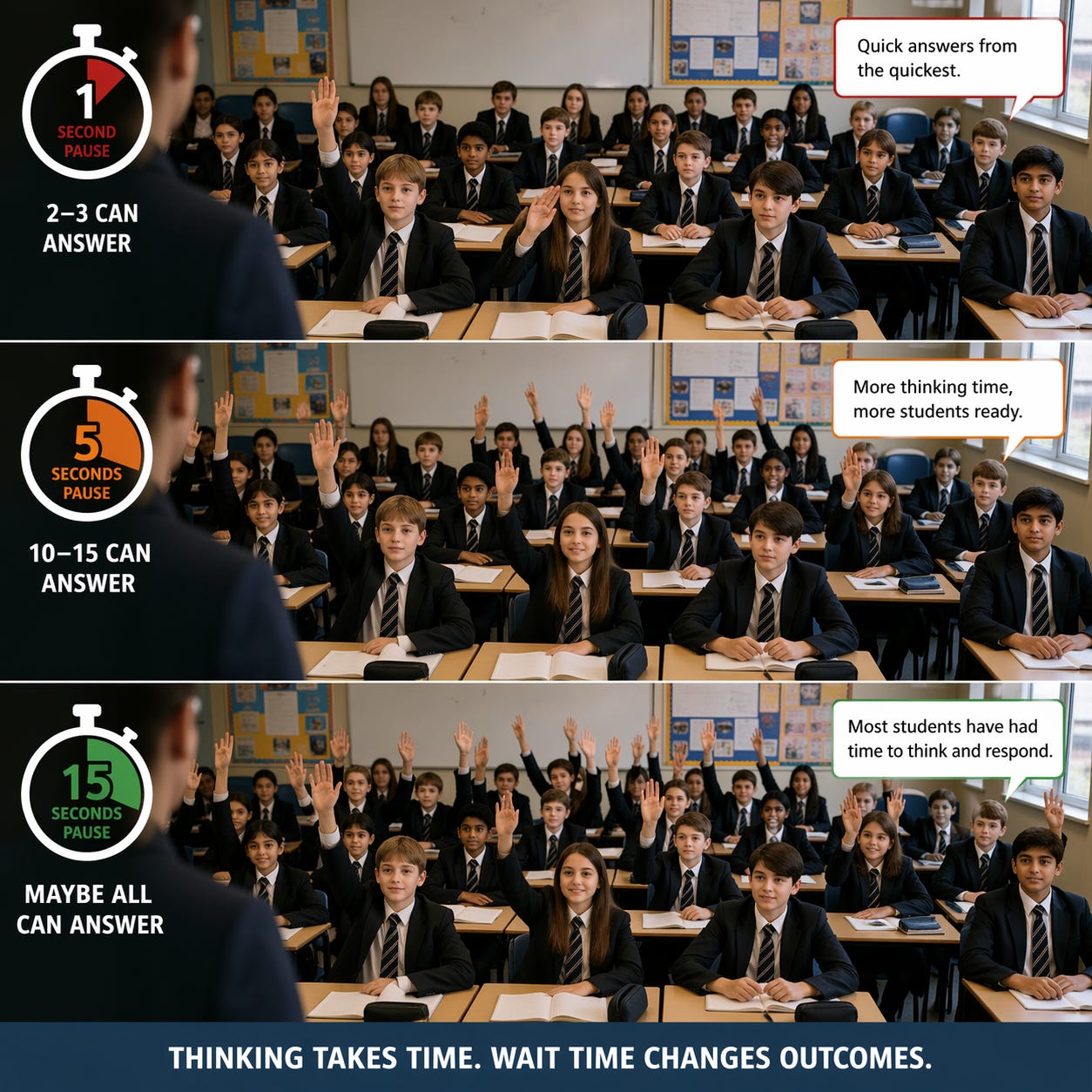
The right amount of wait time will vary with the kind of question being asked. A quick check for attention should need only a brief pause. A question probing understanding will need longer. A question designed to test mastery may need longer still, and may require students to write or rehearse an answer before sharing it publicly. The point is not to fetishise a number of seconds, but to give sufficient time for the kind of thinking the question demands.
One useful technique is fill the wait time by repeating the question after a pause. Not because students didn’t hear or weren’t apyaing attention (although that’s certainly possible) but because repetition extends the thinking window and signals that everyone is expected to keep going. Silence, in this sense, is thinking time. If we want students to think, we have to make time.
Even so, wait time is can be opaque. While we’re waiting, or repeating, it can be hard to be sure what’s happening in students’ heads. Some may be thinking hard. Some may be confused. Some may simply be waiting for lesson to be over. One way to make wait time more purposeful is to build a think-pair-share routine around it.
First, while students think, I ask everyone to jot down notes and ideas on a mini whiteboard. That allows me to circulate, monitor what’s being written, and offer prompts or suggestions where needed. The thinking is no longer wholly invisible. MWBs turn hidden thought into something inspectable. Instead of waiting in the dark, I can see who’s on the right track, and who’s taken a detour.
Then, to increase the likelihood that everyone can give a more developed response, I might ask students to turn to a partner and share their ideas. As they talk, I listen in to as many exchanges as I can, paying particular attention to students who might otherwise be reluctant to participate. Finally, when it is time to share, I’ll often ask students to report what they heard from their partner rather than simply repeat what they themselves have just said. That small shift increases accountability, improves the quality of listening, and makes paired discussion feel more like preparation for whole-class thinking than a brief conversational detour.
Of course, think-pair-share is not automatically productive. Left too loose, it descends into a brief, noisy interlude. Its value depends on the tightness of the routine: everyone writes, everyone talks, the teacher listens in, and the whole-class share is structured so that paired discussion feeds back into the main intellectual work of the lesson.
Wait time should never be seen as an awkward gap between question and answer. Considered properly, it becomes part of the lesson structure and shifts questioning from the privileging of the quickest to benefitting the many.
3. Everyone answers
Every lesson should be a promise to students that everyone will be asked and expected to answer at least one question.
