


This post is the latest in a series focussing on key aspects of different areas of teaching and education.


Feedback is widely claimed to be one of the most powerful things teachers can do. It appears near the top of effect-size league tables, features in almost every school improvement plan, and has acquired the status of professional common sense. If students don’t know how they’re doing, how can they improve?
And yet teachers know from long experience that feedback doesn’t always make the difference it should. If you’ve ever found yourself writing the same comment on the same student’s work for the third time in a term, you’ve probably wondered what the point is. We’ve all felt the frustration of seeing yesterday’s carefully explained correction vanish in the very next lesson. We’ve all experienced the empty ritual of giving out carefully crafted targets which are then ignored the moment students work independently.
But, of course, sometimes things do click. A comment lands, a misconception shifts, and a student suddenly sees what they couldn’t see before and the work they produce is permanently improved. Nothing obvious has changed, and yet everything has. What makes feedback so mysterious is that it can feel powerful, precise and necessary in the moment but disappear without a trace.
The trouble is, we mistake feedback for learning. Following an instruction is not the same as acquiring judgement. Students’ work might look better, but next week the same problem returns wearing a different hat. Or even the exact same hat. More troublingly, feedback can actually reduce performance.
Kluger and DeNisi’s classic 1996 meta-analysis found that in 38% of studies, feedback interventions had a negative effect on performance. In many of the studies they analysed, feedback effects were close to zero, meaning feedback often made little practical difference. So, although some were strongly positive, many were modestly positive. A handful of very large positive effects pull the average upwards which helps explain why feedback effects are often reported as being strong. They may be impressive in the aggregate but, as all teachers know, maddeningly inconsistent in the classroom.
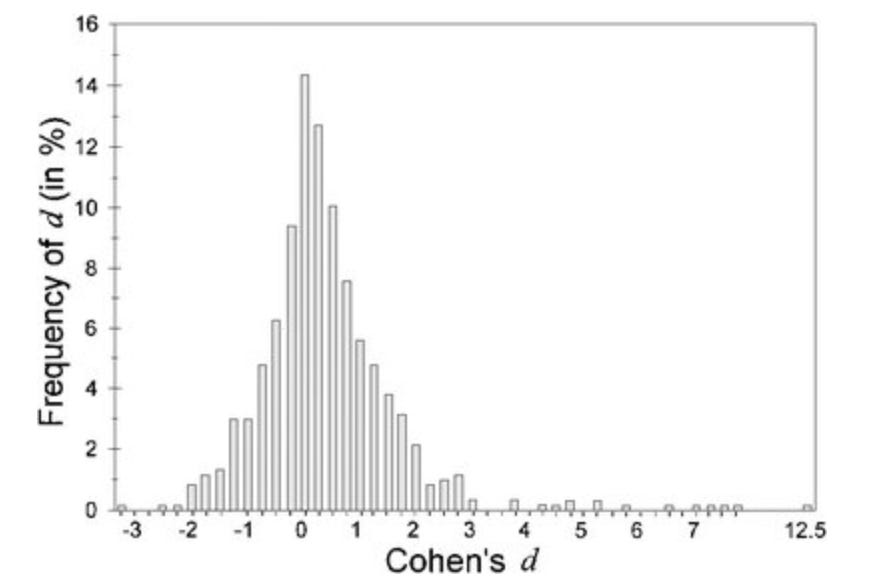
The extreme value of the data point on the far right of the graph (d = 12) should be treated as an outlier rather than as evidence of a normal classroom effect. For clarity, it suggests that in one study the effect of giving feedback was 12 standard deviations which means the feedback group performed so far above the comparison group that the result is almost certainly driven by something unusual in the study design, the measurement, the task, the sample, or the way the effect size was calculated. In real classroom terms, this is not a gold standard but evidence of something very odd. Although the paper shows the distribution of 607 effects, it doesn’t identify which study produced each bar. Its main value is therefore illustrative: a few enormous positive effects help pull the average upwards to the reported average effect of d = .41 and help disguide the sometimes powerfully negative effects of feedback.
Hattie and Timperley make a similar point in The Power of Feedback:
Feedback is one of the most powerful influences on learning and achievement, but this impact can be either positive or negative. Its power is frequently mentioned in articles about learning and teaching, but surprisingly few recent studies have systematically investigated its meaning. This article provides a conceptual analysis of feedback and reviews the evidence related to its impact on learning and achievement. This evidence shows that although feedback is among the major influences, the type of feedback and the way it is given can be differentially effective. [My emphasis]
All this should make us pause. If feedback is so effective, why does it so often fail? If teachers spend so much time giving it, why do students so often ignore it? And if feedback is meant to improve learning, why does it so often merely improve the piece of work in front of us?
The problem is that we tend to treat feedback as a substance. The more of it we pour over students, the more learning we’ll get. But feedback isn’t fertiliser; it’s information. And information doesn’t cause improvement unless students understand it, value it and know how to act on it.
Hattie and Timperley argue that feedback works when it answers three questions: Where am I going? How am I going? Where to next? In other words, effective feedback clarifies the goal, helps students understand the gap between current and desired performance, and gives them some useful sense of their next steps. They also distinguish between feedback directed at the task, the process, self-regulation and the self. The most useful feedback tends to focus on the task, the strategy or the student’s capacity to monitor and improve their own work. The least useful is feedback directed at the self, including much of what passes for praise. Feedback can be powerfully effective when it directs attention to the right thing at the right time.
Sadly, there’s no magic cheat code. One of the few things we can reliably infer from the research on feedback is that there’s no formula for perfect feedback. Anyone who says there is, is either misinformed, selling something, or in urgent need of spending more time in classrooms. Written comments, whole-class feedback, verbal feedback, live marking, codes, rubrics, exemplars, model answers and one-to-one conversations can all work but, equally they can all fail. What matters is whether the feedback fits the student, the task, the subject, the phase of learning and the reason for the gap.
So, rather than asking which feedback method works best, we need to ask what feedback is supposed to do. The answer can, I think, be boiled down to five principles:
Feedback should build judgment, not dependence
Feedback must respond to current performance
Feedback must change with the phase of learning
Feedback should avoid ‘ego involvement’
Feedback must be used, not just received
1. Feedback should build judgement, not dependence
The purpose of feedback shouldn’t be to improve students’ performance in the here and now but to ensure that improvement shows up elsewhere and later. This may sound obvious, but so much of what passes for feedback is really editing in disguise. We spot an error, explain the problem, supply the improvement and the student makes the desired change without being any the wiser. The work is improved but not the student.
In English, this is particularly easy to see. A teacher writes, “Develop this point,” or “Embed your quotation,” or “Link back to the question.” The student dutifully adds a sentence, drops a quotation into the middle of a paragraph and repeats a word from the question in the final line. The essay may now look better but has the student learned anything? Do they know why one quotation is more effective than another? Can they see the difference between a genuine conceptual link and repetitive waffle?
In his classic account of formative assessment, D Royce Sadler argues that students need a concept of the standard being aimed for, the ability to compare their current performance with that standard, and some understanding of how to close the gap. Crucially, this doesn’t giving more feedback. Sadler’s point is that students must come to share in the teacher’s evaluative expertise. They need to recognise quality while they are working, not merely be told afterwards that quality was absent. As he puts it, “students have to be able to judge the quality of what they are producing and be able to regulate what they are doing during the doing of it.” Feedback, then, shouldn’t just consist of information transferred from teacher to student but be part of the process by which students develop their own judgement. The aim is for them to become less dependent on feedback over time.
It might appear that Hattie and Timperley cut against my claim that feedback should change the student, not the work. After all, they argue that the most useful feedback tends to focus on the task, the process or the student’s capacity for self-regulation, while the least useful feedback is directed at the self. Doesn’t that mean feedback should focus on the work rather than the student?
Only if we confuse the target of attention with the purpose of feedback. Feedback should focus on the work because that’s where improvement can be made visible. But its purpose is to change the student: what they notice, what they understand, what they can do, and how well they can monitor their own performance next time. The more specific teachers are the better students’ attention is focussed where it belongs: “Your second sentence explains the effect of the image; now make the first sentence do the same,” keeps attention on the task, the process and the next action. Although the immediate focus is the sentence, the intended change is in the student’s judgement.
Students need to internalise ways of noticing what matters. When feedback moves students from correction, to strategy, to self-monitoring, they move from seeing only what the teacher points it out to being able to see it for themselves.
With simple tasks, the gap may be obvious. Where there’s a binary condition — the answer is either right or wrong, a capital letter is missing or present, the procedure has broken down at the third step or it hasn’t — students can be shown the error, practise the correction and get better. But not all tasks are like this. Some domains are relatively ‘kind’ with clear goals, stable criteria and easily visible errors. Spelling, arithmetic procedures, grammatical accuracy, scales on a musical instrument and many aspects of pronunciation fit this pattern. In kind domains, feedback can often be precise and direct because the relationship between error and correction is clear.
Other domains are more ‘wicked.’ Goals are harder to define, quality is contested and improvement depends on taste, discrimination, context and accumulated knowledge. Writing an analytical paragraph, interpreting a poem, evaluating a historical argument or composing an original piece of music can’t be improved simply by being told the answer. In wicked domains, feedback has to teach students to see.1
The difficulty is that students often don’t know what they’re looking at. They can see the words on the page, the explanation in the exercise book or the pattern on the map, but they can’t yet see the quality of the move they need to make. They don’t know whether an explanation explains, whether evidence has been integrated or merely dropped in, whether a pattern has been described or just accounted for. In these cases, feedback has to draw attention to the feature of quality the student has not yet learned to notice.
English
Task: Explain how Shakespeare presents Macbeth as vulnerable to manipulation.
Students’ response: “Macbeth is ambitious because he wants to be king.”
Weak feedback: “Develop this point.”
Better feedback: “This identifies Macbeth’s ambition, but it doesn’t explain why ambition makes him vulnerable. Add a sentence explaining how wanting power makes him easier for the witches and Lady Macbeth to manipulate.”
The student needs to learn that writing an essay isn’t about simply adding more words but explaining relationships:
ambition → vulnerability
vulnerability → manipulation
manipulation → action.
Science
Task: Explain why increasing temperature affects the rate of reaction.
Student response: “The rate of reaction increased because it got hotter.”
Weak feedback: “Use scientific keywords”
Better feedback: “You’ve identified temperature, but you haven’t explained what changes when the temperature increases. Add a sentence explaining that the particles move faster, collide more often, and are more likely to collide with enough energy to react.”
The student needs to learn that a scientific explanation isn’t about naming the condition that changed. It’s about explaining a complete causal sequence:
higher temperature → greater particle speed
greater particle speed → more frequent collisions
more frequent collisions with enough energy → faster rate of reaction
Geography
Task: Explain why population density is higher near the river.
Student response: “The population is higher near the river because there is water.”
Weak feedback: “Explain why water affects settlement.”
Better feedback: “You’ve identified water as a factor, but you haven’t explained why it attracts settlement. Add a sentence linking the river to farming, transport, trade or industry, then decide which factor is most important in this location.”
The student needs to learn that geographical explanation isn’t about naming a feature on the map. It’s about explaining how physical and human factors interact in a particular place:
river → water supply, fertile land or transport
water, land or transport → farming, trade or industry
farming, trade or industry → higher population density.
The pattern is the same in all three examples. Better feedback points out both what the student can currently see and what they are missing. The feedback then focuses attention on a feature of quality: relationship, causal sequence, mechanism, interaction, precision. The next step requires the student to act on that feature, not merely comply with an instruction.
This distinction between kind and wicked domains helps explain why generic feedback policies so often disappoint. If we treat all tasks as if they belong to the same kind of domain we shouldn’t be surprised when students struggle to make progress. A missing apostrophe and a weak interpretation of Macbeth are not the same kind of problem, however much a tracking spreadsheet might give the appearance they are. In kind domains, feedback may correct an error. In wicked domains, feedback has to build discrimination.
If feedback improves the artefact but leaves the student no better able to judge quality, it will make students more not less dependent.
2. Feedback must respond to current performance
Feedback doesn’t act directly on learning. Kluger and DeNisi’s Feedback Intervention Theory suggests that feedback works by drawing attention to a discrepancy between current performance and a goal. What happens next depends on how the student responds to that discrepancy. The student might increase effort, change strategy, lower the goal, reject the feedback or disengage altogether. The key variable is attention. Feedback is more likely to be beneficial when it focusses attention on the task and the next action; it’s more likely to backfire when it shifts attention towards the self. This explains why the same piece of feedback can land so differently with two different students.
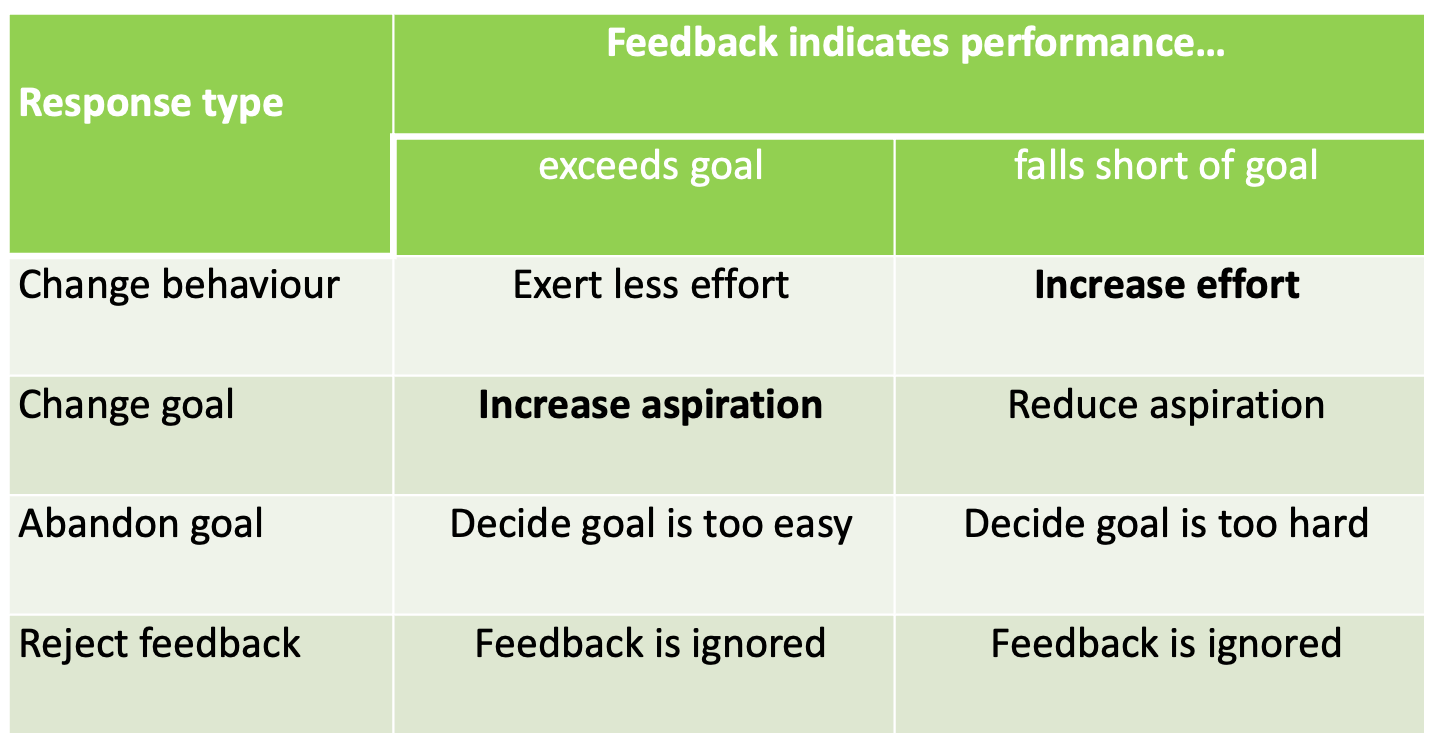
The table above shows why feedback so often fails to do what we want or expect. If our feedback tells students they are exceeding expectations, they may choose to aim higher, but they may also decide the task is under control and reduce thier effort. They may conclude that the goal was too easy to be worth pursuing, or simply ignore the feedback altogether. Only one of these choices (aim higher) is desirable and so feedback must be consciously titled towards this end.
The real problem comes when students are falling short. Feedback is only useful if it results in them trying harder and changing strategies, but that’s only one possible response. All too often students decided to aim lower, give up entirely, or reject the feedback and disengage.
The feedback we give doesn’t determine the path students take. Feedback creates a discrepancy between current performance and the desired goal. Clear, accurate, precise feedback will always backfire if the discrepancy it reveals is too overwhelming, humiliating or hopeless. We often assume that pointing out the gap will lead students to close it, but students are acting rationally when they protect themselves from the gap instead. The key question is not just whether the feedback is correct, but whether it makes productive action more or less likely.
Saying, “You need to make your explanation more precise” might be exactly what a confident student needs but for a student who barely understands the content, it may simply confirm how lost they are. The same words but a very different effect.
Feedback must therefore be adjusted according to current performance. If students are broadly meeting expectations, feedback can refine, extend and complicate. It can draw attention to nuance, invite comparison and raise aspiration.
In maths, a student who can reliably solve a linear equation might be asked to compare two methods and explain which is more efficient, or to solve a problem where the equation has to be constructed first. The feedback shifts from “do the next step” to “choose the best route”.
In PE, a student who can perform a basic lay-up might be asked to adjust the timing under defensive pressure, use the weaker hand, or decide when not to take the shot. The feedback should focus on how they can adapt techniques to make them more useful in game situations.
In music, a student who can play the notes accurately might be asked to shape the phrase, control dynamics, or compare two interpretations of the same passage. Instead of being asked to play the correct notes they might respond better to being prompted to make different musical choices.
When students are failing to meet expectations, feedback may need to redirect attention, reteach content, simplify tasks, clarify goals or rebuild the conditions for success. There’s little point offering sophisticated feedback to a student who has misunderstood the question, lacks the necessary knowledge or cannot see what success is supposed to look like.
Crucially, feedback also has to make renewed effort feel worth the effort. If students have already tried harder and still got nowhere, why would they listen to someone telling them to try again? “More effort” is only motivating when students can see how that effort might pay off. Otherwise, it just sounds like nagging. So feedback must offer a strategy worth trying. It has to show students what to attend to, what to change, and why this next attempt might be different from the last. The message shouldn’t be, “Try harder,” but, “Try this.”
