

Couch to 5k Writing
From sentence structure to essay mastery

I’m delighted to announce that my new book, Writing Fitness, is available for pre-order. Co-written with Rikki Cole, it’s a complete, step-by-step programme on how to teach writing from sentences to essays.
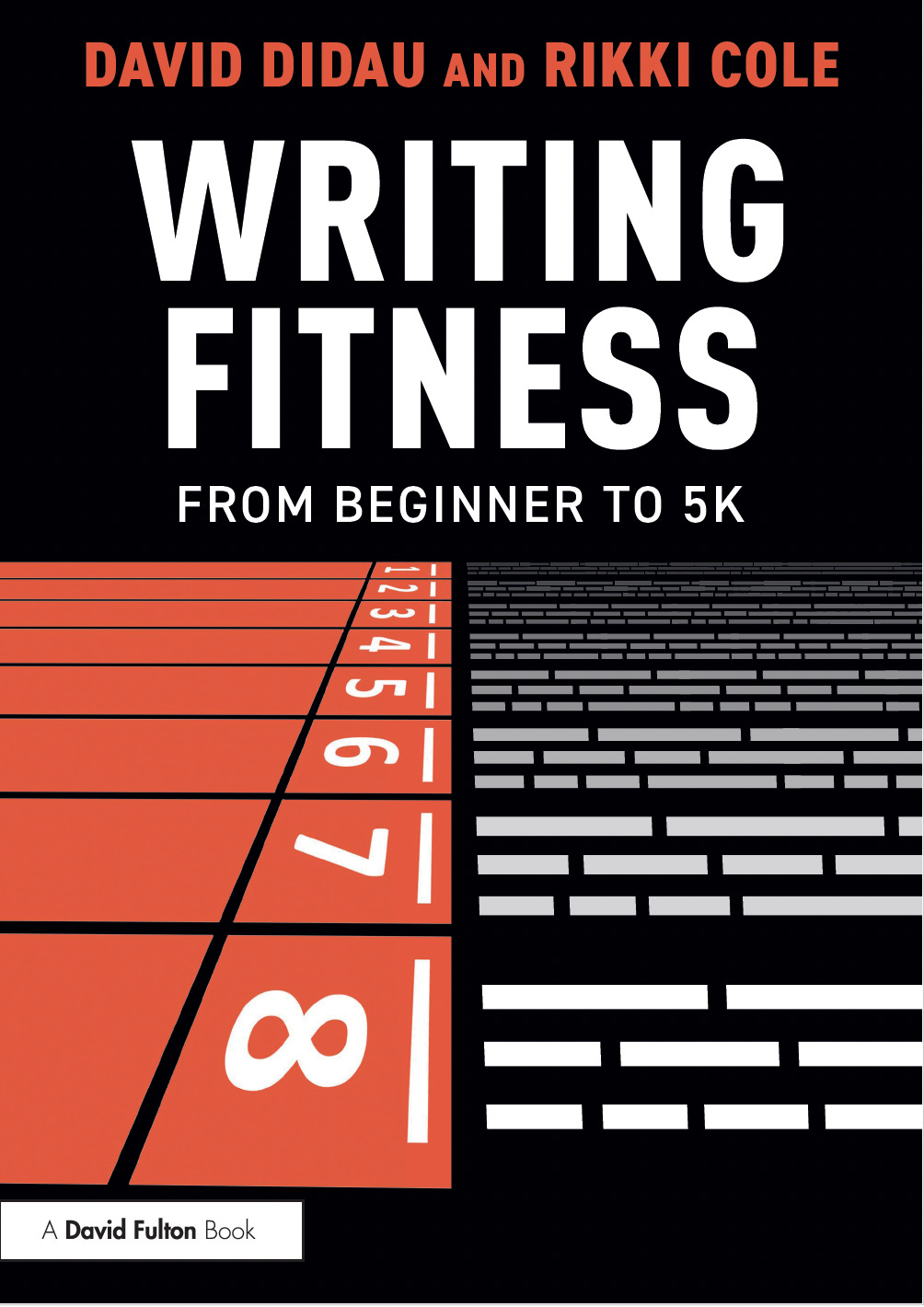
Writing Fitness starts from a simple but neglected observation: writing is one of the most cognitively demanding things students are asked to do, yet we routinely expect them to produce extended pieces long before they have mastered basic syntax. The result is predictable. Writing feels uncomfortable, error-ridden and demoralising, and effort is mistaken for progress.
The book rejects the idea that writing is a generic skill that can be picked up through exposure or endless essay practice. Instead, it treats writing as a body of knowledge. Grammar, syntax, vocabulary and structure are the means by which thought is shaped. If students struggle, the problem is usually not motivation or ability, but gaps in what they have been taught.
The central metaphor is borrowed from the Couch to 5K running programme. Nobody becomes a runner by being told to run five kilometres on day one. Progress comes from short, achievable bouts of practice, repeated often, with complexity added only once fluency is secure. Sadly, we’re not able to use Couch to 5k Writing as the title of the book due to concerns about intellectual property, so instead we’ve gone for Writing Fitness. The book applies the same logic as the running programme to teachingwriting. Sentence-level fluency comes first, paragraphs follow and full extended essays are built up to over three years. Expectations of what all students are capable of producing are extremely high, but cognitive load is managed by reducing quantity and increasing quality.
We have deconstructed of the analytical essay into nine distinct sentence types: thesis statement, controlling idea, topic sentence, evidence, analysis, evaluation, comparison, context and counter-argument are taught and practised explicitly, in isolation, before being combined. Students learn to express dual perspectives through subordination, to embed interpretation in epithets and appositive phrases, and to use precise analytical verbs rather than vague commentary. Over time, this shifts writing from knowledge-telling to knowledge-transforming.
Writing is never treated as a bolt-on. Practice is embedded in the curriculum, rooted in the texts and ideas being studied. Short, low-stakes routines build accuracy and control, while repetition across Key Stage 3 allows habits to become automatic. Scaffolds are used deliberately and then removed, leaving behind durable patterns of thinking.
The argument is radical. If taken seriously, it would mean less pointless marking of sprawling essays and more attention to what students are actually practising. It would mean seeing struggle as information about instruction, not some vaguely character-building ambition. And it would mean accepting that, as with running, writing fitness is built through patience, precision and practising day after day, lesson after lesson.
1: Gapless Instruction
This chapter establishes the case for gapless instruction by showing how writing failure disproportionately affects the most disadvantaged. When writing is treated as an implicit skill, those without access to academic language outside school are left guessing. Writing is reframed as the product of knowledge and practice, not talent or effort. The chapter explores the curse of knowledge, explains why experts routinely underestimate what novices need to be taught, and sets out principles for curriculum design that build cumulative knowledge through precise sequencing. Writing is positioned as an action that improves through repetition, not a static ability students either possess or lack.
2: Success before struggle
Writing places extreme demands on working memory, and this chapter explains why asking novices to struggle too early leads to failure rather than resilience. Sink-or-swim approaches overload attention and produce brittle performance rather than learning. Drawing on Cognitive Load Theory, the chapter shows how success can be engineered through step-by-step instruction that builds schema before complexity is increased. High expectations are preserved, but difficulty is introduced deliberately, avoiding the working memory bottleneck that causes writing to fall apart under pressure.
3: Perfecting Practice
Practice only improves writing when it is carefully designed. Because practice makes permanent, poorly structured tasks entrench weak habits rather than eliminate them. Popular formulas such as PEE are critiqued for encouraging surface compliance rather than cognitive control. The focus shifts to teaching with precision before expecting polished products, embedding habits that endure beyond individual tasks. Proofreading is reframed as a powerful learning process that sharpens attention and reinforces accuracy.
4: From talk to thought
Spoken language and written language operate under different constraints, yet students are rarely taught how to move between them. This chapter shows how structured talk can be used to develop academic language and how writing itself functions as a form of thinking. Syntax is presented as a cognitive lever, with particular sentence structures prompting particular kinds of reasoning. Writing becomes a means of shaping ideas, not simply recording them.
Chapter 5: The Deconstructed Essay
At the heart of the book, the Deconstructed Essay is introduced as a way of making analytical writing teachable. Essays are broken into discrete components that can be practised in sequence, allowing students to move from knowledge-telling to knowledge-transforming. The chapter traces the full progression from thesis statements and epithets through evidence, analysis, evaluation, comparison and context. Academic verbs are foregrounded as tools for precision, and extended arguments emerge as the cumulative result of sentence-level mastery.
6: Constructing creativity
This chapter challenges the belief that structure suppresses creativity. Instead, creativity is shown to depend on constraint, with slow writing and carefully chosen sentence structures enabling deliberate idea generation. Writing creatively is framed as thinking in sentences, where choices are made consciously rather than left to inspiration. The chapter demonstrates how creative routines can be embedded across the curriculum rather than isolated in occasional free-writing tasks.
7: Integrating writing into the curriculum
Writing is often sidelined by content pressure, and this chapter explains why. It argues that writing improves most when it is embedded in the curriculum rather than taught as a separate unit. The C25K Writing model is shown in action, including extended examples from Macbeth, to illustrate how fluency can be built while preparing students for GCSE demands. Writing becomes a throughline of curriculum design rather than an end-of-unit performance.
8: The Pedagogy of C25K Writing
This chapter focuses on the everyday decisions that make writing instruction effective. It identifies the questions teachers need to answer in every lesson about attention, understanding and consolidation. Emphasis is placed on routines that require all students to think, with mini-whiteboards used to make understanding visible and errors actionable. Teaching must be responsive rather than assumptive, with clarity and mastery taking precedence over curriculum coverage.
9: Improving writing through assessment
The final chapter positions assessment as a form of instruction rather than judgement. It challenges the dominance of rubrics and generic success criteria, arguing that assessment should focus on learning rather than performance. Only what has been explicitly taught should be assessed, and mastery should be evaluated through precise, curriculum-aligned tasks. Comparative judgement is explored as a more reliable way to evaluate extended writing, and feedback is framed as a tool for designing next steps rather than closing conversations.
To get hold of free, downloadable C25K writing resources, visit C25KWriting.org
And, if you’d like to explore how to embed C25K Writing in your school, please get in touch: ddidau@gmail.com
On tour in Oz
I’m very excited to be visiting Australia for the first time in March. I’ll be speaking at researchED Ballarat on Saturday 14th but also be leading several one day workshops on Couch to 5k Writing: from sentence structure to essay mastery.
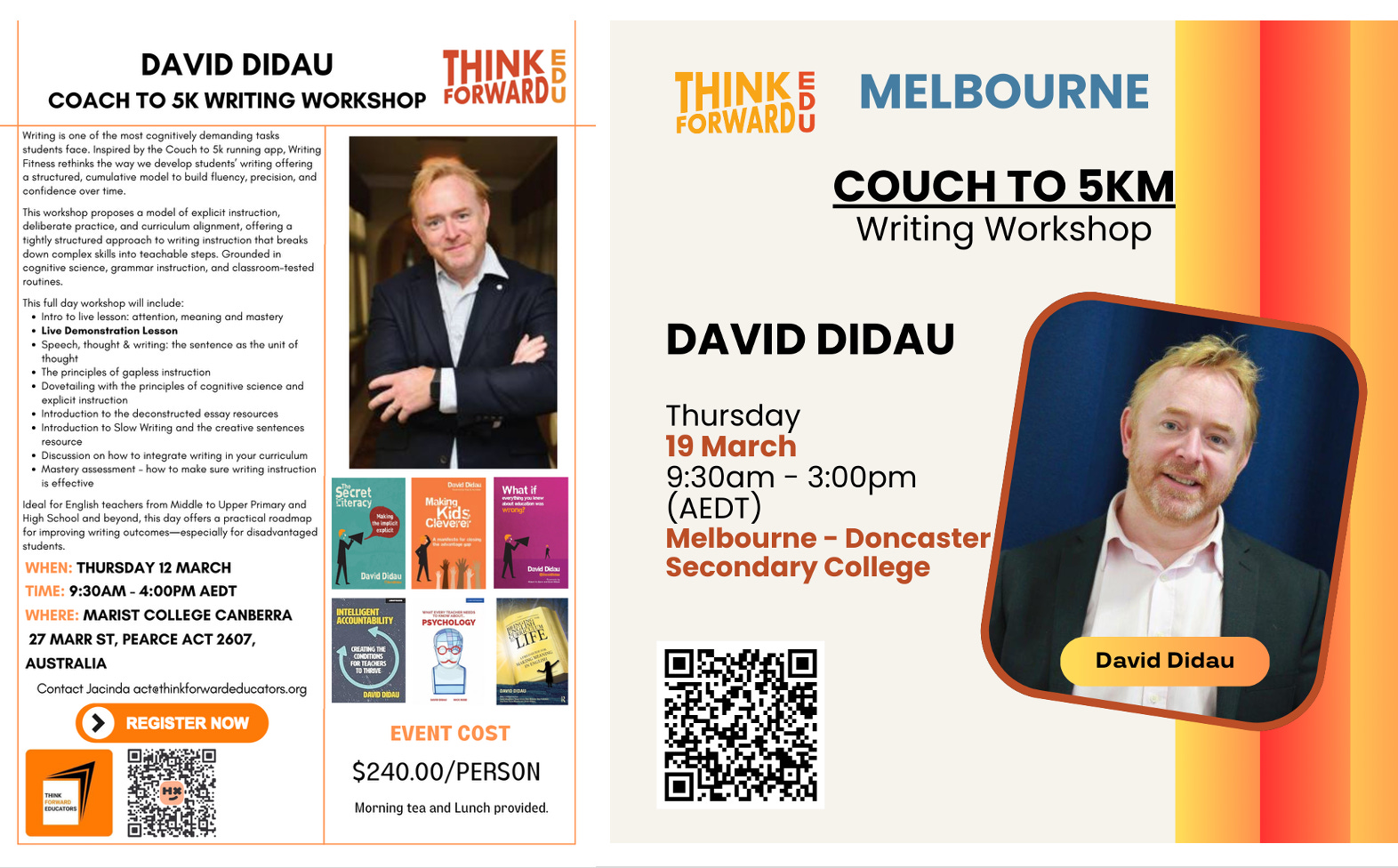
Perth - Monday March 23 (details tbc)
Sydney - Tuesday 10th March: Better teachers, better teaching (with Carl Hendrick)

Game changing!
This is an absolute game changer- had the privilege of working with @David Didau and @Rikki Cole - my students get a better deal as a result