


Sisyphus, in the ancient myth, is condemned to an existence that is generally acknowledged to be awful. He is condemned eternally to a task that is boring, difficult, and futile … There is no value to his efforts; nothing ever comes of them.
Susan Wolf, Meaning in Life and Why It Matters, p. 17.
The gods of ancient Greece punished Sisyphus, king of Ephyra, for his hubris1 by condemning him to an eternity of pushing a huge rock up a hill only to have it roll back down again as soon as he reached the top. Pushing a boulder up a hill with no prospect of ever reaching the top has become the very image of futility. Most of us are prepared to persist with something difficult when we believe our efforts might eventually pay off, but when we stop believing this, persistence starts to look less like resilience and more like stupidity. Students are no different. Why should they work hard if they can’t see how their efforts might result in success?
But, existence is equally pointless if we never meet any resistance. We improve by encountering the limits of what we can currently do and attempting to move beyond them. If everything is effortless, there’s no reason to change: no errors to correct, no gaps between intention and execution, and no need to develop a more sophisticated understanding. It’s great to get increasingly fluent at doing what we can already do, but fluency quickly plateaus. To feel that there’s a point to what we’re doing, success and struggle have to be balanced.
Fifteen or so years ago, it was common to encounter schools where it was considered important for students to experience failure. This would, it was thought, encourage children to develop resilience, grit, and other wonderful sounding transferable traits. A few schools even developed ‘failure days’ in which students were given tasks that were impossible to ensure their efforts met with failure.2 It may be that some students benefit from this sort of experience but those who’ve never experience success in school are unlikely to become more resilient by experiencing yet more failure.
More recently, I’ve become increasingly aware of schools that use the concept of ‘desirable difficulties’ to justify giving students tasks that they’re unable to do. The thinking is, as far as I understand it, that by failing to do difficult things students will somehow develop a taste for trying harder and embracing challenge. If difficulty is good, the reasoning seems to go, more difficulty must be better. If students aren’t succeeding, perhaps they just need to struggle for longer. This is, in my view, naive.
The phrase ‘desirable difficulties’ was coined by Robert Bjork in 1994 to describe conditions of learning that create challenges during practice but improve long-term retention and transfer. By 2011, Robert and Elizabeth Bjork described four particularly well-established examples: spacing, interleaving, variation and retrieval practice.3 As Bjork explains it, desirable difficulties are those that, “appear to impede performance during training but that yield greater long-term benefits than their easier training counterparts.”
But how do we know when a difficulty leads to long-term benefits? By definition, this is something we’re not going to be able to see in the here and now. Helpfully, in their 2011 paper, the Bjorks make it clear that if, “the learner does not have the background knowledge or skills to respond to [desirable difficulties] successfully, they become undesirable difficulties.”
This should be obvious but sadly isn’t. Lesson after lesson, day after day, in schools across the world, students are routinely expected to do things no one has ever taught them to do. For instance, students are regularly assessed on their understanding of a subject by being expected to produce a piece of extended writing. It’s vanishingly rare that a teacher will have broken down this writing task into discrete teachable chunks and provided sufficient practice for students to master each element before being expect to get on with it. As a result, some students — the most advantaged — succeed despite not having been taught whereas the least advantage fail precisely because they’ve not received the instruction they so clearly need.
The crucial point is that nothing — whether it’s a retrieval question or an essay — is desirable just because it’s difficult. Difficulty is a cost and is only desirable when the cost results in something worthwhile.
Here then is the definition I find most useful: Desirable difficulties must induces struggle in order to make subsequent success more likely.
Why struggle at all?
Struggle is valuable because improvement requires us to operate beyond what we can already do fluently. Once we can perform something entirely on autopilot, simply repeating the performance is unlikely to produce much further improvement. We might become more confident, but this isn’t the same as becoming more expert.
This is the ‘OK plateau’.4 When we first learn to drive, type or play a musical instrument, improvement is rapid because almost everything requires conscious attention. Eventually we become good enough and practice becomes increasingly automatic. At this point improvement flattens out because we no longer need to think very hard about what we’re doing. We’ve become OK, and being OK removes much of the pressure to get better.
Developing expertise requires attention to the gap between what we can currently do and what we’re trying to do, followed by some effort to close it. Getting off the OK plateau therefore requires deliberately reintroducing difficulty. We have to attempt something we can’t yet do fluently, pay attention to errors and make adjustments. But, although, improvement requires some degree of struggle, there’s an important difference between a difficulty that exposes the next thing we need to improve and one that simply overwhelms our capacity to respond.
But struggling isn’t much fun. Most of us prefer the satisfying fluency of doing something we’re already good at to the awkwardness of discovering that we’re not as good as we thought. Given the choice, we tend to practise our strengths and avoid confronting our weaknesses. If the hill we have to push our boulder up is too steep, most of us will give up.
Success before struggle
Struggle is most likely to be desirable after success has been encoded. By ‘encoded success’ I mean that students have developed a sufficiently clear mental representation of what successful performance looks and feels like. They’ve seen it modelled, experienced some success themselves and have some idea of how to get from where they are to where they need to be.
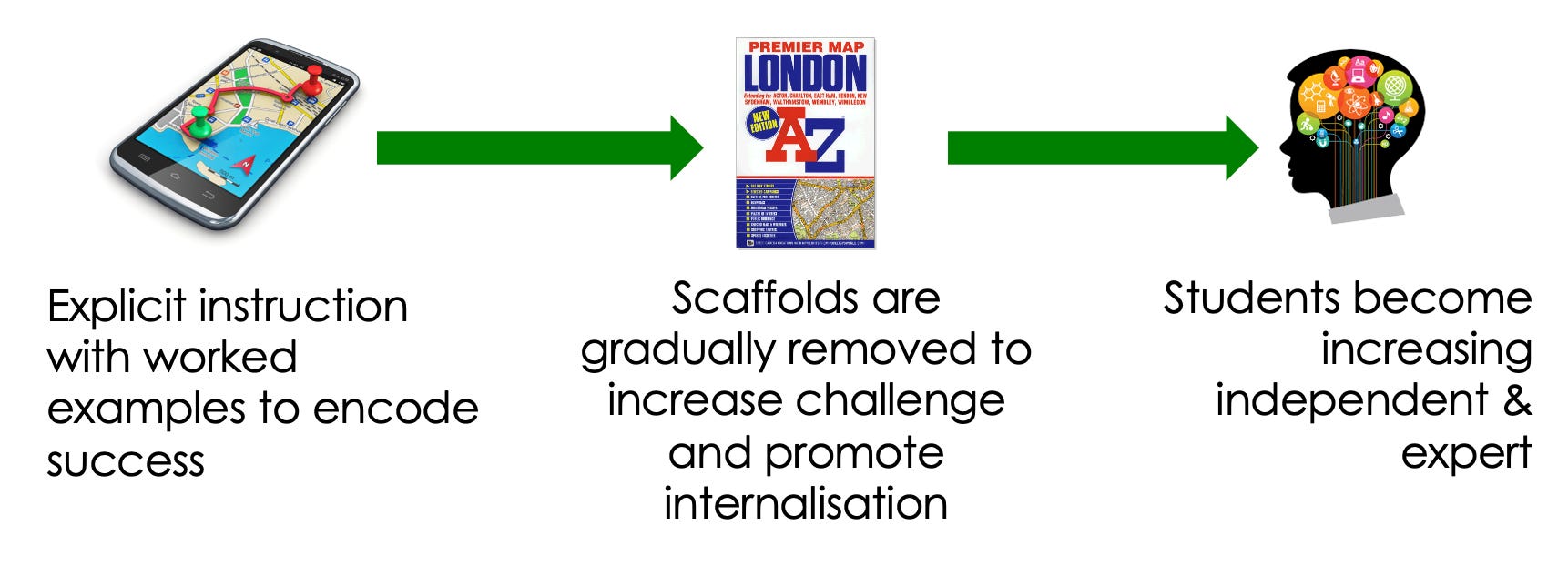
One way of thinking about this is the difference between navigating with a satnav, navigating with a map and knowing the route for yourself. A satnav is the perfect Assessment for Learning machine: it knows exactly where you are, you tell it your destination, and it provides step-by-step feedback on your progress until you reach your goal. If you make a mistake, it adapts and offers alternative instructions. It is so well designed that even the most inept navigators quickly experience success. The downside of this efficiency is that there is little incentive to learn routes.
