

The Feedback Continuum: why reducing feedback helps students learn
Feedback should not seek to perfect performance, but to make learning last

Paul Kirschner recently published this post on reducing feedback. It reminded me of some ideas I put together a few years ago on how to effectively reduce feedback without demotivating students. Paul’s right that reducing feedback gets a lot less attention than the other desirable difficulties and I think that’s because it feels so counter-intuitive not to provide as much feedback as possible. In the post below I set out to clarify what feedback actually does and how thinking carefully about the purpose of what we want to acheive will make it easier to know when and how to provide feeback that genuinely helps students learn.

The effects of feedback are more complex than we often realise. While expertise and mastery are unlikely to develop without feedback, it’s certainly not true to say that giving feedback results in expertise and mastery. There are vanishingly few teachers who do not prioritise giving feedback and yet not all teachers’ feedback is equally effective. There is a clear concensus in education that feedback is crucial. And yet.
Take a look at the abstract for John Hattie and Helen Timperley’s 2007 paper, The Power of Feedback:
Feedback is one of the most powerful influences on learning and achievement, but this impact can be either positive or negative. Its power is frequently mentioned in articles about learning and teaching, but surprisingly few recent studies have systematically investigated its meaning. This article provides a conceptual analysis of feedback and reviews the evidence related to its impact on learning and achievement. This evidence shows that although feedback is among the major influences, the type of feedback and the way it is given can be differentially effective. [My emphasis]
That’s rather startling, isn’t it? Although feedback is hugely powerful, it’s “impact can be either positive or negative.” Maybe just giving feedback willy-nilly is something to be avoided? Do we perhaps need to be a bit more mindful about what we’re doing?
We know from Kluger & DeNisi’s meta-analysis that in 38% of the most robust studies they were able to find, giving feedback had a negative impact on outcomes. So what goes wrong?
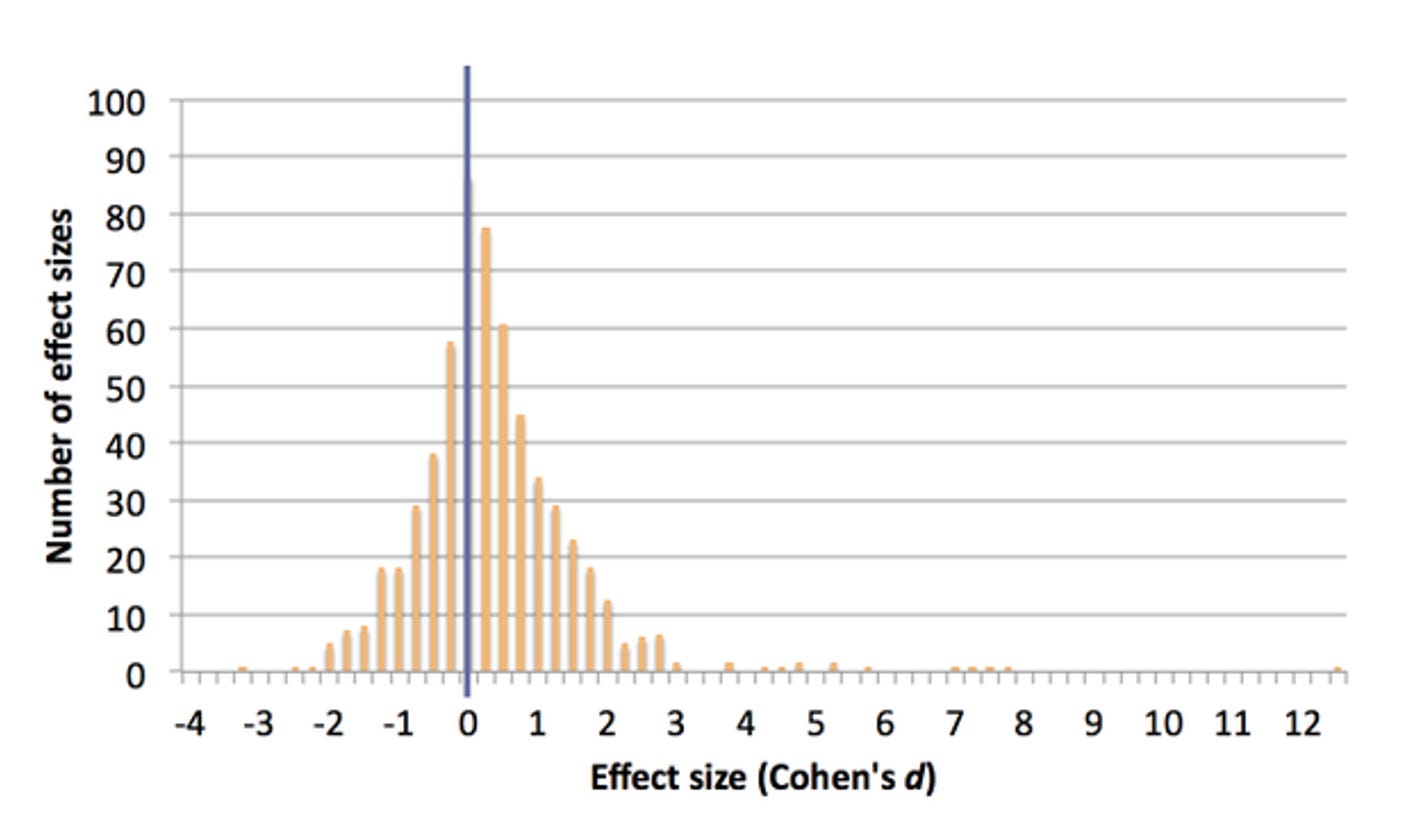
It’s interesting to consider the view from cognitive psychology. As Soderstrom and Bjork point out, there is empirical evidence that “delaying, reducing, and summarizing feedback can be better for long-term learning than providing immediate, trial-by-trial feedback.” Further, they point out that,
Numerous studies—some of them dating back decades—have shown that frequent and immediate feedback can, contrary to intuition, degrade learning.
This claim might seem to contradict your lived experience. After all, as every teacher knows, if you give students feedback on how to improve their tennis backhand, essay writing or the process by which to solve quadratic equations they will then make these improvements. There is no doubt whatsoever that giving feedback will improve students’ performance but sadly this does not mean that these improvements will be retained or transferred. In fact, there’s compelling evidence that giving students cues and prompts to improve performance in the short term actually reduces the likelihood of retention and transfer.
Learning vs performance
The underlying issue is that performance and learning are not the same, and feedback is often aimed at the former while being assumed to serve the latter. Performance is what we see in the moment: fluent answers, neat work, rapid improvement across a lesson. Learning is what remains, when the task changes and the scaffolding has been taken down. Feedback reliably improves performance because it tells students how to adjust right now. What it does not reliably do is ensure that those adjustments are understood, remembered or transferable.
This is where so much well intentioned practice goes wrong. When feedback is immediate, frequent and highly specific, it acts as a substitute for thinking. Students do not need to hold rules in mind, compare alternatives or evaluate the plausibility of their own responses because the environment does that work for them. Success is externally regulated. The result is often impressive short term gains paired with fragile long term understanding.
Learning, by contrast, depends on internal regulation. Students need to retrieve what they know, test it against the task, notice mismatches and decide how to respond. Feedback can support that process, but only when it leaves something for students to do. When feedback is delayed, reduced and summarised, it forces students to reconstruct their own thinking and check it against a standard. That effort is precisely what strengthens flexibility and durability.
The analogy of navigation
Using a map is effortful and it’s easier to memorise routes than to have to map read your way to every destination, especially if you intend to go there more than once. A SatNav, on the other hand, is the perfect Assessment for Learning machine. Its GPS knows exactly where you are, you tell it exactly where you want to go and it provides immediate, trial-by-trial feedback on your progress. If you make a mistake it adapts and provides new instructions to compensate for the error. Navigation becomes effortless and memorising routes is hardly worth the trouble.
Map reading, on the other hand is effortful. I’m the sort of person that has to rotate a map to make it conform more easily to reality. I find this so stressful that I’m higkly motivated to look out for landmarks, remember routes and only use the map when I’m desperate.
When we compare this to the way feedback is given in schools it’s no very great stretch to see how students might become dependent on their teachers for feedback. If teachers give too much feedback too quickly and don’t encourage their students to struggle, it’s hardly surprising that students would avoid taking the trouble to memorise procedures and processes.
So, does this mean that the only feedback we should give is of the map reading variety? To answer this question we need to understand that feedback has two potential effects; it can promote learning and it can also promote confidence. The trouble is, these effects are often at odds. In order to promote learning feedback should induce struggle and be designed to get students to think hard about subject content, but to promote confidence it needs to be designed to encode success and give students the belief that they can successfully tackle a problem. If there is too much struggle involved in attempting a task we may end up encoding failure with the result that students might believe that they ‘can’t do maths’ or that they’re ‘crap at French’.
My suggestion therefore is to adapt the type of feedback we give depending on where students are in their studies. If they’re at the beginning of a course they will lack the knowledge to successfully perform a task without carefully scaffolded feedback. Being shown how to perform well and being given ‘SatNav feedback’ will help motivate them to see that they can be successful. However, such feedback is unlikely to promote learning. Therefore, as time goes by and students become increasingly confident, teachers ought to reduce the amount of feedback they give and raise their expectations of how much struggle students can reasonably cope with. At this stage, the most effective kind of feedback is of the ‘map reading’ variety. Having to struggle helps students recognise that it’s worth the effort to memorise how to solve specific types of problems and to internalise certain procedures. Once these things have been internalised, students are no longer dependent on teachers’ feedback and performance becomes increasingly effortless. By the time the end of a course is approached there should be little need for teachers to give feedback at all, as students ought to have learned everything they need to be successful.
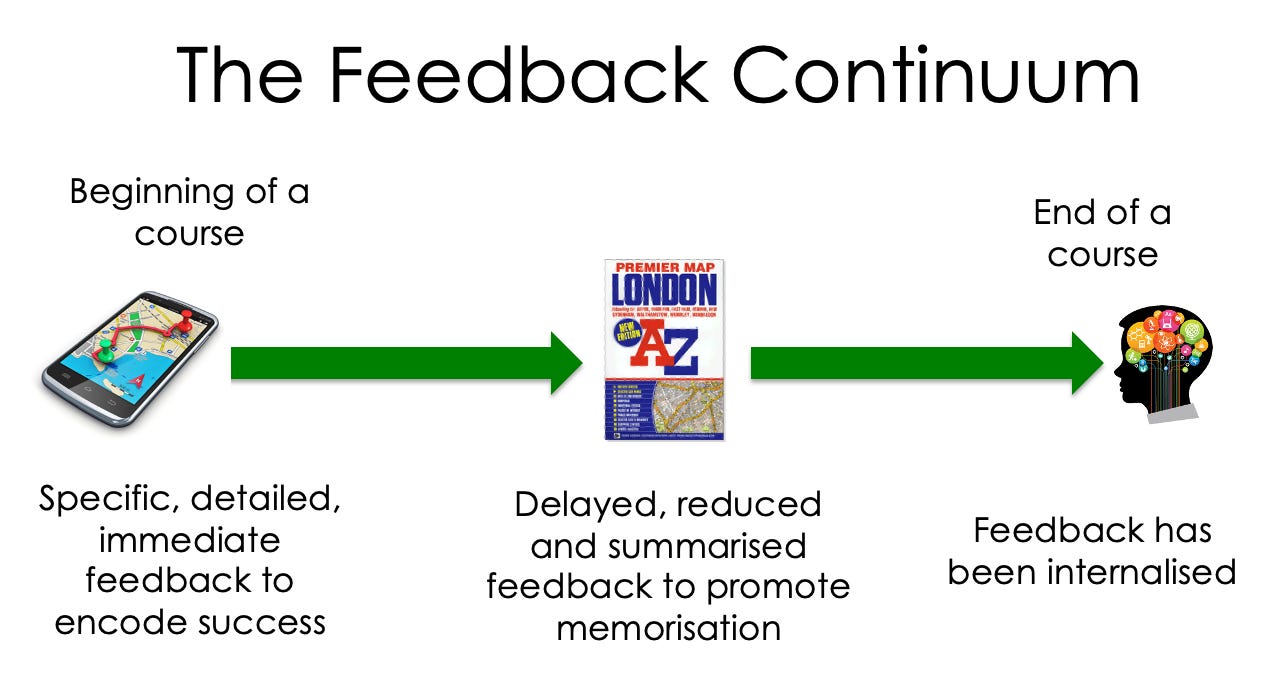
This then is my suggestion for a feedback continuum. Lots of SatNav feedback at the beginning to promote confidence and encode success. Then we should increasingly reduce, delay and summarise feedback to promote the retention and transfer of the concepts and procedures we need students to master. The more effortful it is to follow feedback, the greater the likelihood that students will find ways to make do without it. Finally, as students have internalised what needs to be learned, teachers should see giving feedback as a last resort and as evidence that teaching has been ineffective.
What is feedback for?
Kluger and DeNisi’s Feedback Intervention Theory suggests that feedback does not act directly on learning at all. Instead, it operates by drawing attention to a discrepancy between current performance and a goal. What happens next is not determined by the feedback itself, but by how a student responds to that discrepancy.
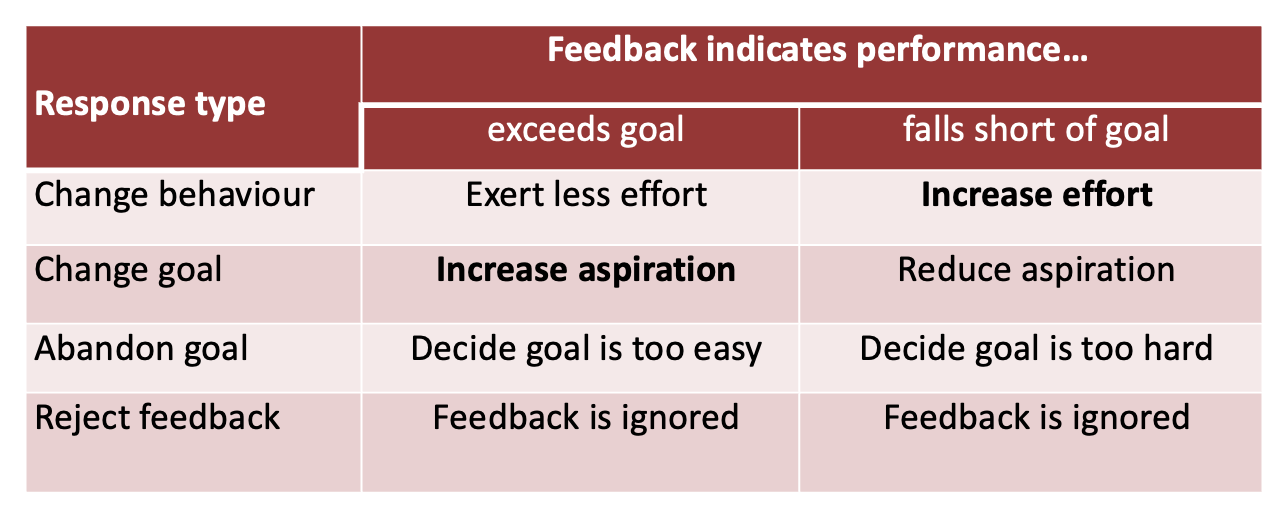
When feedback indicates that performance exceeds the goal, students have several rational options. They may decide to exert less effort because the task feels under control. They may raise the bar and increase their aspiration. They may decide the goal was too easy to be worth pursuing. Or they may simply ignore the feedback altogether. From a learning perspective, only one of these responses even has the potential to be productive, and it is far from guaranteed.
Exactly the same logic applies when feedback signals that performance falls short of the goal. Students might increase effort and try a different approach. They might lower their aspirations to protect confidence. They might abandon the goal entirely on the grounds that it is too hard. Or, again, they might reject the feedback and disengage. The crucial point is that feedback itself does not determine which path is taken. It merely sets the conditions under which a choice is made.
This is why feedback is such a blunt instrument if we ignore where students are in their learning journey. Early on, when knowledge is fragile and success feels uncertain, feedback that highlights failure is far more likely to trigger goal reduction or abandonment than productive effort. Later, once students have experienced success and have a clearer sense of what improvement involves, the same feedback can prompt useful adjustment. The difference is not in the wording of the feedback or in flashy techniques for delivering it but in the student’s capacity to respond by changing behaviour rather than changing or abandoning the goal.
Seen through the lens of Feedback Intervention Theory, the problem with much classroom feedback is not that it is poorly intentioned, but that it is misaligned. We give feedback as if it will automatically produce learning, when in reality it only produces information. Whether that information leads to increased effort, lowered aspiration or disengagement depends on how plausible improvement feels to the learner at that moment. This is another reason why reduced and faded feedback matters. By gradually shifting responsibility for monitoring performance onto students, we increase the likelihood that feedback, when it does occur, leads to behavioural adjustment rather than retreat.
To help further refine an understanding of the types of feedback we might need to provide, it might be helpful to assume that their are three distinct purposes we might want feedback to acheive:
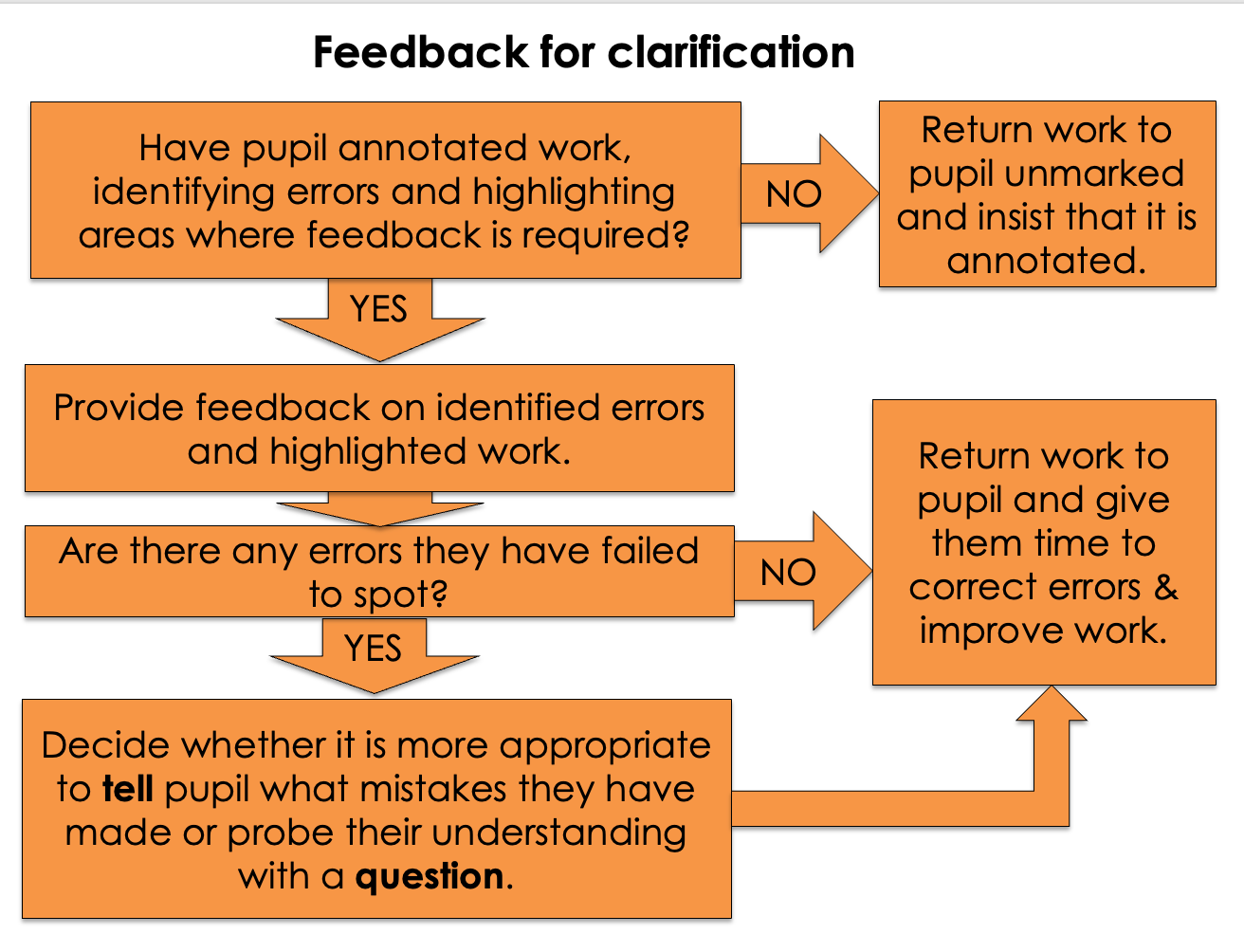
To provide clarity - most mistakes arise because students are unclear about what the task actually requires. Feedback that identifies misconceptions and clarifies what counts as a correct response is therefore an essential starting point. If students do not understand what they are aiming for or why an answer is wrong, no amount of effort or aspiration will help. Get this wrong and everything that follows is built on sand.
To increase effort - feedback has to do more than tell students to try harder. Effort only pays off when it is directed at the right processes. Helping students understand what they should be doing is difficult enough; persuading them to persist in doing it is harder still. Effective feedback makes improvement feel plausible by showing students where effort will actually make a difference.
To increase aspiration - feedback has a different role again. There is value in practising to the point where errors are eliminated, and that can often happen without much feedback at all. But once a goal has been met, learning stalls unless the goal itself changes. Students need to be nudged towards something more demanding. Without increased challenge there are no mistakes, and without mistakes feedback has nothing useful to work on.
Here are the steps we might make to achieve each of these aims:
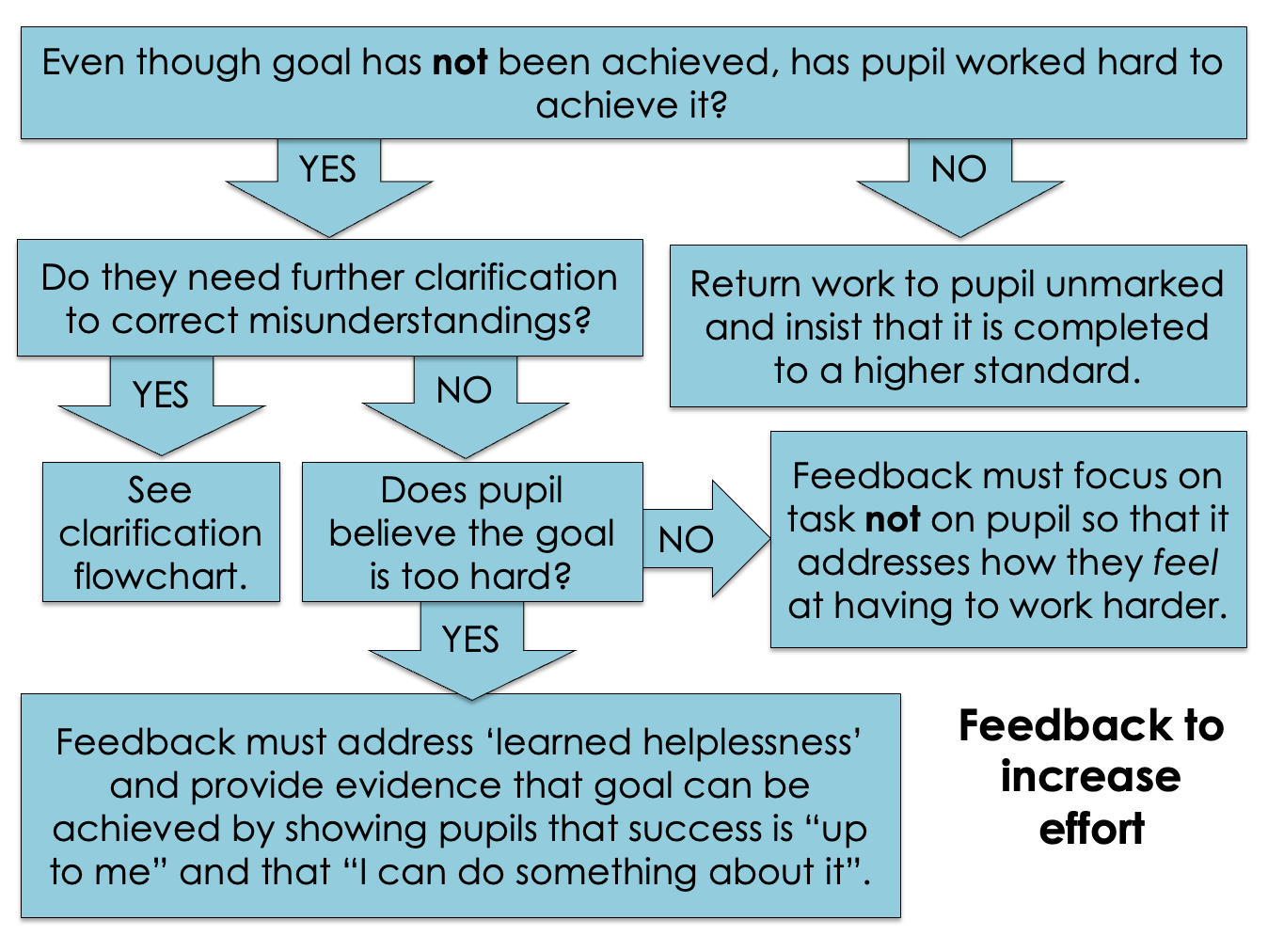
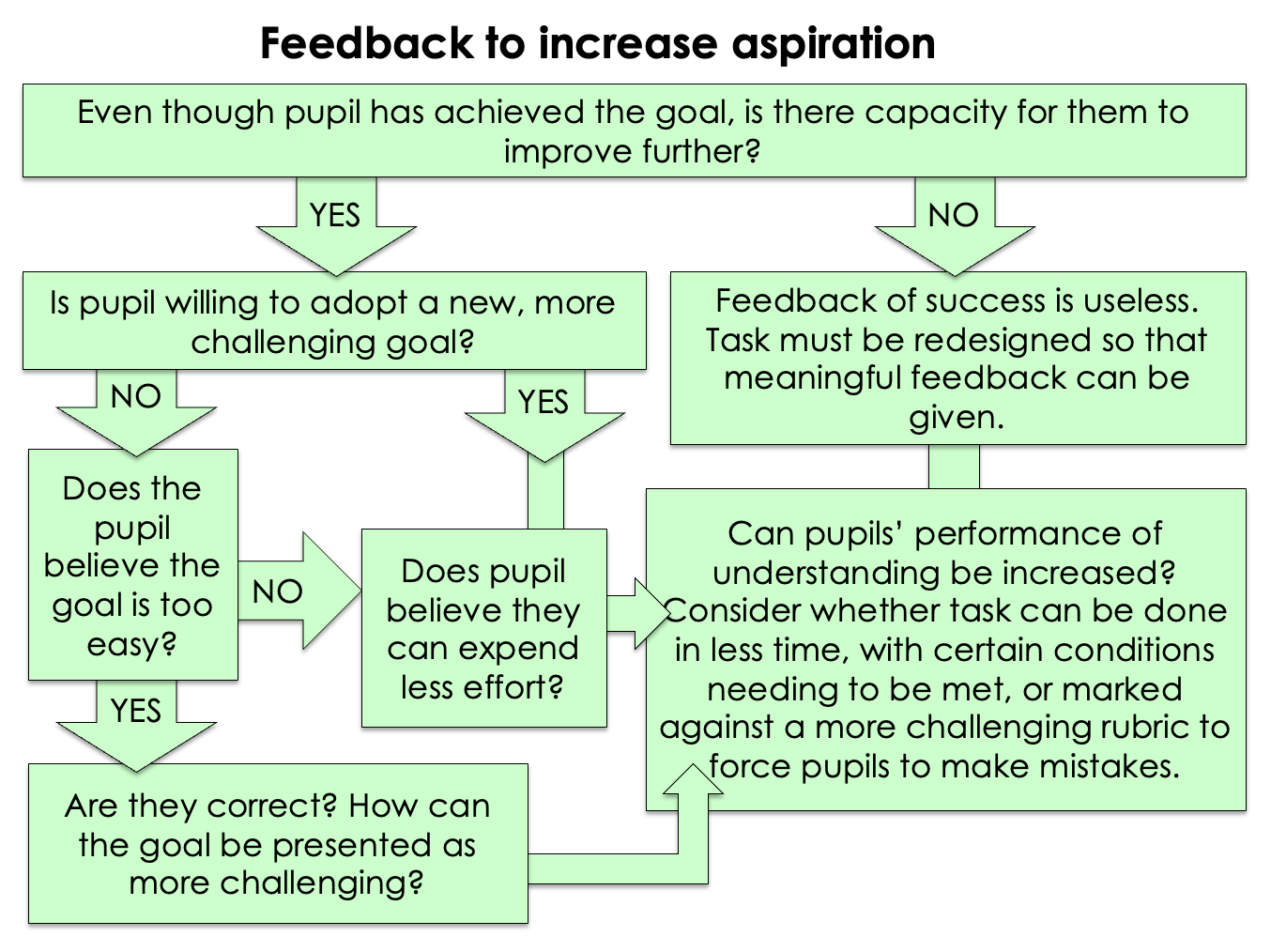
The problem is not so much that feedback is ineffective, but that it’s too effective at the wrong things. It is excellent at smoothing performance and poor at building independence unless it is deliberately designed to be faded out. If we want students who can perform independently, we need to stop treating flawless performance during practice as the goal. The real purpose of feedback is not to eliminate errors, but to help learners learn how to detect and correct them for themselves.
Great post, especially this: "As Soderstrom and Bjork point out, there is empirical evidence that 'delaying, reducing, and summarizing feedback can be better for long-term learning than providing immediate, trial-by-trial feedback.'" And not just because it vindicates my approach with my high school students. Thank you!
Lots of ponder here. It seems as if this approach modifies or qualifies that what falls under the "deliberate practice" model, is that correct? I read Karl Anders Ericsson's book Peak last year, and I thought was fascinating but perhaps too focused on high-performing outliers. I wanted more specifics on how and when to deploy feedback, which you've helpfully provided here.