


For a man to attain to an eminent degree in learning costs him time, watching, hunger, nakedness, dizziness in the head, weakness in the stomach, and other inconveniences.
Don Quixote, Cervantes
Cervantes makes learning sound wonderfully unpleasant. More interestingly, though, he treats it as a state we attain rather than a thing we can do. You can look industrious, attentive and scholarly without necessarily having learned anything at all. Equally, you might appear confused and unsuccessful while learning a great deal. Which raises an interesting question: what exactly do we mean by learning?
Learning (n.)
the retention and transfer of knowledge
a change in the way the world is understood
When I give talks or conduct training, I always make a point of defining my terms. Although I’ve written about learning many times before, it seems useful to set out exactly what I think the word means.
Learning is tripartite: it involves retention, transfer and change. It must be durable (it should last), flexible (it should be applicable in new and different contexts) and liminal (standing at the threshold of knowing and not knowing).
If we accept these ideas, then we should also accept that learning cannot be observed in the here and now. The only way to see if something has been retained over time and transferred to a new context is to look at what students can do elsewhere and later. Cognitive development happens gradually and by increments; the only way to find out whether a student's understanding of the world has changed is to wait and see. While learning takes place in the present it is only detectable in the future.
From this certain things must follow...
To know whether something has been learned we should ask ourselves three questions:
Will students still know this next week, next month, next year?
Will students be able to apply what they have been learning in a new example, a new subject, a new place?
How will this transform students’ understanding of the world?
If we routinely asked these questions, teaching might look rather different.
The main conclusion I’ve come to is that although we know learning occurs, we can’t actually see it. Learning is like dark matter; it exerts a sort of gravitational pull that reveals its existence but it takes place inside students’ minds. All we can see is what a student is able to do at this moment in time. We can’t see what they’ll be able to do at another time or in another place.
One of the most useful and important concepts for teachers to understand is the distinction between learning and performance.1 Performance is what students can do now. Writing an essay, solving an equation, answering a questions, taking part in a sports match or musical recital are all performances. Performance is not inherentently good or bad, but it’s all we can ever observe.
Learning, however, takes place inside a student’s mind and as such cannot be observed directly. We can make inferences about learning based on the performances we see, but, performance at the point of instruction is a particularly poor predictor of learning. What students can do in a lesson — or in response to feedback — tells us very little about what they might be able to do at another time and in another place. Teachers provide cues and prompts which increase students’ performance in lessons. And students are skilled at mimicking what they think teachers want to see and hear. This mimicry can result in learning but often doesn’t.
If students solve a bunch of equations immediately after watching a teacher complete similar equations it may seem obvious that they’ve learned to solve equations. But what happens next week when faced with unfmailiar examples and the teacher’s explanation is no longer fresh in their minds?
Performance during instruction is often positively misleading. Conditions that make students appear successful now can leave surprisingly little behind, while conditions that produce more errors and hesitation seem to lead to better retention later. This is one of the more counterintuitive findings from cognitive psychology: reducing current performance can actually increase future learning. If students struggle to perform well during instruction, if they have to dredge in their memory to remember what they should do, this seems to make their memories more flexible and durable.
Each item in memory has a storage strength and a retrieval strength. Storage is how well an item is embedded in long-term memory. Retrieval is how easily an item can be brought to mind when needed. Retrieval strength predicts whether we can recall something here and now; storage strength whether we can recall it elsewhere and later.2
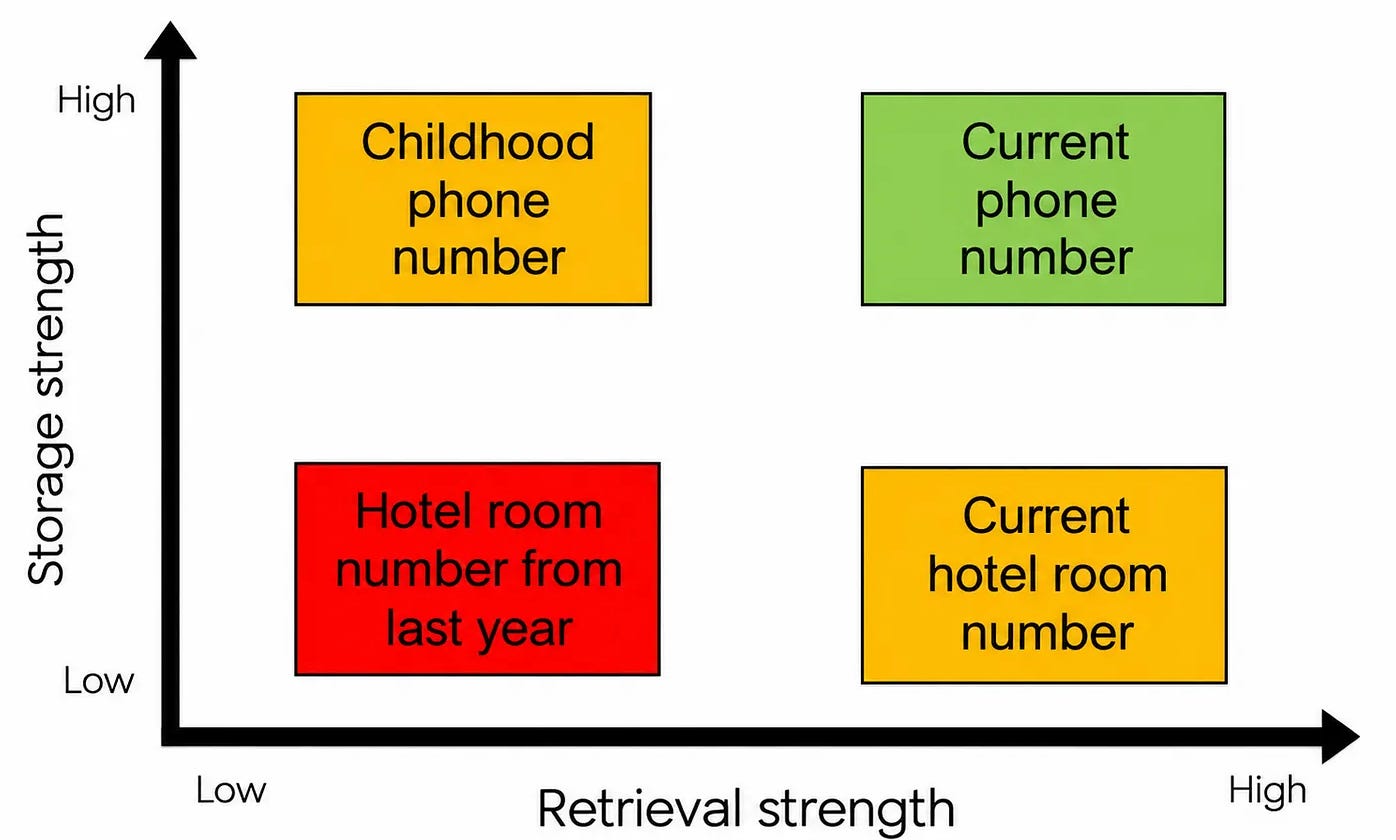
The distinction helps explain why a student can answer a question correctly on Monday only to have forgotten everything by Friday. We tend to assume the knowledge has disappeared but it might be more accurate to say that its retrieval strength dropped. The bulk of classroom activities are oriented to improving performance rather than learning; propping up retrieval strength instead of bolstering storage.
So how do we increase storage strength? This is where it becomes productive to introduce ‘desirable difficulties’ into lessons. A desirable difficulty is a task that requires effort without tipping into failure. It reduces performance in the short term, but strengthens retention and transfer. Crucially, it is not a single hard task but a sequence of carefully calibrated challenges, supported by feedback, that gradually raise the level of demand. For the difficulty to be desirable it must be pitched to induce struggle but, crucially, result in success. If difficulty becomes overwhelming, it stops being desirable.3
Not only does retrieving something after it’s become less accessible strengthen subsequent memory, but repeatedly retrieving something while its retrieval strength is high actively degrades storage strength. Paradoxically, forgetting before successful retrieval results in better learning.
Ordinarily, we think of forgetting as the enemy enemy but in fact it seems to be an essential precondition. The caricature of someone desperately repeating something over and over to ensure they won’t forget it only works in the very short term. So much teaching is ineffective because it works on the same principle. Instead, the difficulty caused by trying to recall something that has slipped our mind signals our mind to store it for future use. Provided successful retrieval is possible, effort strengthens memory and make future retrieval more likely.4
When students are flying through a task, answering every question correctly and producing exactly what we hoped to see, it’s tempting to congratulate ourselves on how much they’ve learned. Perhaps they have. But perhaps we’ve merely engineered the conditions in which successful performance is easy.
The test of learning comes when some of those conditions are taken away. If we haven’t yet looked elsewhere and later, we simply don’t know.
This brings us the the final part of my three-part definition. Liminality is the crossing of a threshold: what was once strange and unfamiliar becomes obvious; what was difficult becomes straightforward; what couldn’t previously be understood is now just how the world is. But we can’t know that a threshold has been crossed simply because a student performs successfully while we’re helping them across it. Learning is revealed by what students can do independently.
Here are three examples of liminality in action:
When the teacher asks, ‘What two things are being compared?’ students might be able to spot a metaphor but they don’t really know what it means to think metaphorically. Crossing the threshold means beginning to see language differently. Choices that were previously invisible become available. Metaphor stops being merely a feature to spot and becomes a way of thinking.
A student may successfully solve simultaneous equations immediately after watching a worked example, but that doesn’t mean they understand when or why simultaneous equations are useful. Crossing the threshold means beginning to see problems differently. Weeks later, they encounter an unfamiliar problem and recognise, without prompting, that simultaneous equations offer a way to solve it.
Fresh from discussing the Treaty of Versailles, a student may readily explain why it fuelled resentment in Germany. Here, the first-order knowledge is secure enough: they know what happened. The threshold is crossed when this changes their grasp of second-order concepts such as causation, consequence and significance. They begin to see the rise of the Nazis not simply as the next thing that happened, but as something requiring explanation through connections between events, conditions and decisions.
Once learning has crossed the threshold, it becomes difficult to remember what it was like not to know. Reading, manipulating numbers, recognising irony or understanding why seasons occur come to seem obvious. Knowledge changes the world we experience. We don’t merely possess something we didn’t previously know; we become unable to see the world as we once did.5
Learning must be durable enough to be retained, flexible enough to transfer and liminal enough to change what students know and understand.
In ‘Learning Versus Performance: An Integrative Review’, Soderstrom and Bjork define learning as “relatively permanent changes in behavior or knowledge that support long-term retention and transfer”, whereas performance refers to “temporary fluctuations in behavior or knowledge” observable during or immediately after instruction.
Bjork, R. A., & Bjork, E. L. (1992). ‘A new theory of disuse and an old theory of stimulus fluctuation’.
The concept of desirable difficulty was developed by Robert Bjork to explain why conditions that make learning feel harder can nonetheless improve long-term retention and transfer (Bjork, 1994; Bjork & Bjork, 2011). The key mechanism is that effortful retrieval strengthens retrieval strength without undermining storage strength, provided the task remains achievable. Empirical evidence shows that learning conditions associated with lower immediate performance, such as spaced practice, retrieval practice, and reduced guidance, often produce superior long-term outcomes compared to more fluent, easier conditions (Bjork & Linn, 2006; Roediger & Karpicke, 2006). However, this effect depends on success. When difficulty exceeds learners’ current capacity, performance collapses, errors dominate, and learning suffers, a finding consistent with research on cognitive load and errorful learning (Sweller, Ayres & Kalyuga, 2011). Desirable difficulties work successful effort strengthens memory in ways that passive or overly supported practice does not.
Storm, B. C., Bjork, E. L., & Bjork, R. A. (2008). “Accelerated relearning after retrieval-induced forgetting: The benefit of being forgotten.”
In Threshold concepts and troublesome knowledge: Linkages to ways of thinking and practising within the disciplines’ (2003) Meyer and Land describe threshold concepts as transformative because they change how a subject is understood and irreversible because, once understood, they’re difficult to unlearn or to see from the perspective of someone who doesn’t yet understand them.
Thank you, David, for this article!
What caught my eye was not the distinction between performance and learning, but the condition that difficulty must result in success.
It raises another question: under what conditions?
The same retrieval task can create productive struggle for one learner and become overwhelming for another, or even for the same learner under different levels of cognitive load. The difficult part seems to be the calibration: when does desirable difficulty become simply too difficult?